
| 1 | Europe’s most recognisable snake |
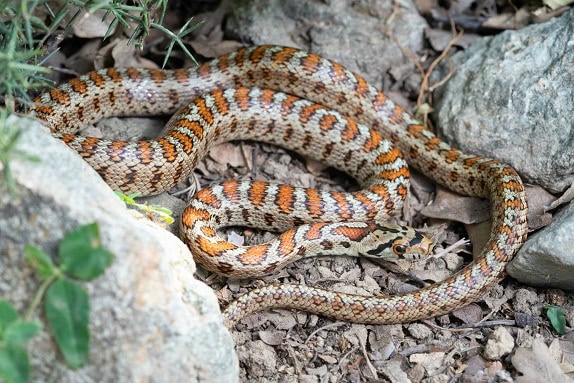
The leopard snake (Zamenis situla) is a species found in southeast Europe, including Greece, Albania, Croatia and parts of Italy, which lacks any form of venom and is unable to kill a human being. This species is often confused with a viper, but is actually a colubrid, one which subdues its prey using constriction.
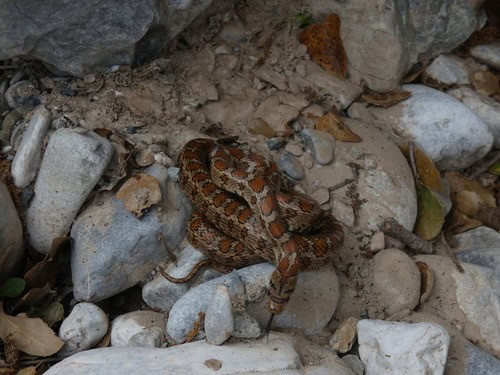
Leopard snakes are very difficult to confuse with any other European snake. In fact, they’re easily recognisable even among the 4000 snakes worldwide. The main reason for this is their colourful blotches, which contrast vividly with the stony grey background. Leopard snakes have dozens of these rounded markings, which are densely packed on the spine, and become sparser on the flanks. Each blotch has a darker outline, with a reddish interior.
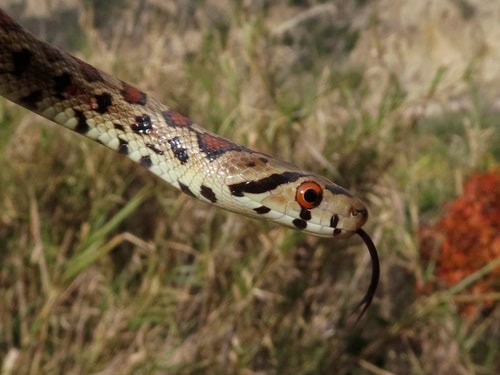
Another simple ID technique is examining the facial patterns. From a side view, the leopard snake has two clear black markings: 1) a black line beginning above the eye and stretching diagonally backwards, and 2) a black line extending vertically below the eye. This is consistent in virtually all individuals, male and female, Italian and Greek.
| 2 | Offensive/defensive techniques |
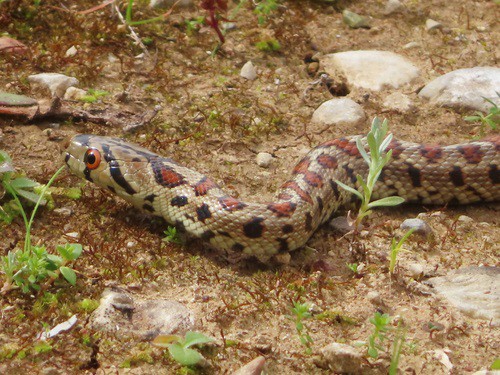
The leopard snake’s first survival strategy is to stay hidden, whether in a dark burrow or in a dry stone wall. If cornered, this snake is incapable of causing serious damage, but can be aggressive, coiling up and striking people with its snout, followed by an actual bite. Leopard snakes are more than willing to bring fang to flesh and draw blood in surprised villagers or farmers.
In captivity, leopard snakes may stay aggressive forever, never fully calming down, remaining nippy for years. According to one keeper, the leopard snake “remains somewhat nervous, even after a long period in captivity“.
Another leopard snake tendency is vibrating the tail. It lacks a rattle, but can swish its tail slightly at such high speeds that a noise is produced, similarly to its relative the Aesculapian snake.
Leopard snakes aren’t particularly fast, compared to their neighbour the green whipsnake. Their reactions are relatively poor, as they tend to freeze for a while when flustered, before leaving the scene. Becoming roadkill is a common fate for this snake.
| 3 | Lurks in old stone walls |
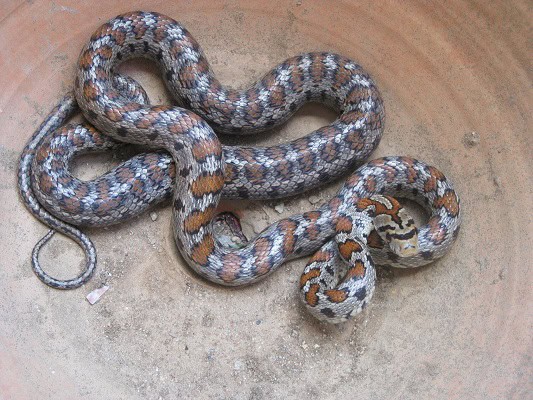
Leopard snakes are closely related to the Aesculapian snake, AKA Zamenis longissimus, but the latter lacks the memorable blotches and could never be confused. Their habitats are also different. Leopard snakes are nearly always found in dry, open territory with plenty of rocks. In particular, they have a tendency to appear in old, crumbling human structures. They have a strong liking for old stone walls in rural areas, lurking between cracks and gaps in the stacked rocks.
You can also find this species in citrus and olive plantations, including decorative olive trees planted in gardens. Leopard snakes are abundant on plains and grassy hillsides, particularly in sunny areas covered with shrubby vegetation. Unlike their Aesculapian snake cousin, they avoid dense forests, but can be found in lightly wooded areas.
The largest leopard snake of all time measured 120cm, while another measured 116cm with an injured tail, and could have been longer if fully intact. Other habitats include riverbanks, scree slopes, field edges and road embankments. The leopard snake is a terrestrial species, rarely climbing trees.
| 4 | Strange Italian rumours |
Leopard snakes are so abundant in southeast Italy that odd rumours have developed, including one of the “pomegranate snake”, or scursuni dè ranati.
Local farmers state that newborn leopard snakes are completely plain and pattern-less. They pass their vulnerable early weeks by lurking amid the roots of pomegranate trees, which are plentiful in the lush countryside of southeast Italy. When the ripened fruits drop to the earth and release their purplish seeds, the young leopard snakes devour them. They use the juicy fruit to grow their intensely coloured blotches, which appear the following spring.
Another rumour is a more common one in Europe – that leopard snakes steal farmers’ milk by sucking the udders of cows, goats and sheep. Some farmers in Puglia beat the leopard snake to death after mistaking it for a viper.
In Catania, this snake has the nickname of ncarravacchi or “stable snake” due to its habit of searching for small rodents in barns and farms. Other Italians call it pastoravacche or “cow-shepherd” after the milk-drinking rumours. The reality is that no snake has ever been observed to drink milk from a barnyard animal (although many old Italians would disagree).
| 5 | Another ID sign |
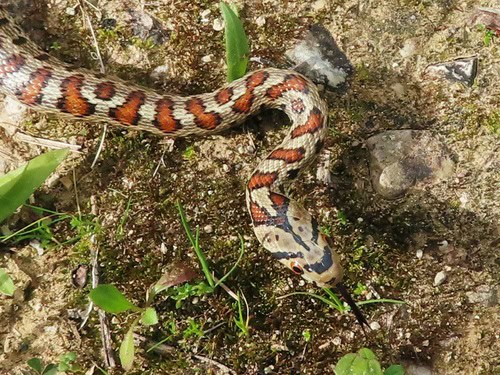
Leopard snakes are also easily recognisable from a bird’s eye view. Firstly, there’s a vivid black stripe connecting the two eyes, as a thick bendy blotch. Most interesting is a distinctively-shaped marking which begins on the neck.
This takes the form of a Y, or a fork, beginning with a sharp point on the head towards the eyes. This is followed by a straight shaft, before two prongs appear as the neck approaches. It also slightly resembles a dual candlestick. The upper snout of the leopard snake is different to the body; much bronzer than the usual grey.
Leopard snakes aren’t strictly nocturnal or diurnal. They usually spend their mornings basking in the sun, on a stone wall or bare dry field. They follow this by resting in the shade, before revving up for their most active period: late afternoon and early evening. Leopard snakes cannot tolerate the hottest weather, and become more nocturnal during temperature extremes.
| 6 | A scattered empire |
Most snakes worldwide have a large continuous piece of territory, while a few have a large territory plus a distant outpost. One great example is DeKay’s brown snake, which is abundant in the eastern USA, but has a mysterious unexplained population in Guatemala and Honduras. The leopard snake is part of this club, with some of the most outposts of any snake.
This species’ empire is all over the place, with the main bulk lying in the Balkans, including Albania, North Macedonia, Croatia, and especially Greece, where it covers virtually the entire country. This territory fizzles out in western Turkey, coming nowhere close to Lebanon or Syria.
To the northwest, the leopard snake’s territory ends in Croatia … but then you have Italy. The leopard snake somehow has a completely isolated colony in southeast Italy, bordering the Adriatic Sea. This has never been explained, as a connecting land bridge didn’t form here during the last ice. It’s theorised that Romans released them deliberately, after returning home from wars with exotic new pets. However, this isn’t proven.
| 7 | A mysterious island population |
That isn’t all, as Italy has a second isolated colony in Sicily, located hundreds of miles from the Adriatic colony. The same is true for Malta in the Mediterranean, another unexplained outpost. 1000 miles away, Crimea in southern Ukraine has a thriving population of leopard snakes, whereas the rest of Ukraine has none, and neither do Romania and Moldova between the nearest mainland colony in Bulgaria.
Leopard snakes also appear on many of Greece’s scattered islands, including Crete, Sifnos, Paros, Serifos, Andros, and Milos, where they coexist with the endemic Milos viper. A single observation has been made in Cyprus as well, although this is an ongoing mystery – the population could be rediscovered one day, or it could have been an escaped pet all along.
On the mainland, leopard snakes are abundant near Athens and Thessaloniki. They generally appear from 0-700 metres, but can reach as high as 1600 metres. In Croatia, Bosnia and Montenegro, they become more common as you approach the coast. Occasionally, leopard snakes can be found in cities, such as Catania in Sicily.
| 8 | Two pattern variations |
Leopard snakes have little variation in colour, but have two classic morphs; blotched and striped. The former is easily the most common, and consists of the regular reddish round blotches with a black outline, becoming smaller down the flanks, and converging to a Y or fork-shaped marking on the neck, sharpening to a point on the head.
The second morph is far rarer – a striped morph, with distinct parallel stripes continuing to a more detailed head. This morph is particularly common on the Adriatic coast of Italy, accounting for 50% of individuals in some spots. But elsewhere, in Italy, the blotched form rules.
These morphs aren’t distinct subspecies, as they regularly intermingle in the same locations. The striped and blotched versions are simply superficial morphs, like the Malabar pitviper of India, which can sprout blue, green and pink at will.
Leopard snakes have only minimal sexual dimorphism, as males and females are virtually identical in patterns. In Italy, the striped morph is slightly more common in females, and females are slightly longer as well.
| 9 | Possible lookalikes in Greece/Balkans |

The leopard snake has no real lookalikes once you understand its main ID signs, but there’s a few snakes which might confuse a beginner:
Dice snake – a semi-aquatic species with a mild venom, which sometimes spews blood from its mouth (autohaemorrhaging) to convince predators it’s dead. This species inhabits most of Greece and has blotchy patterns as well. However, these are much less distinct, sometimes more like fingerprint smudges. They tend to be pure black, without the red inner colour. The base colour of this snake is olive rather than grey.
European catsnake – this snake could inspire confusion due to its preference for rocky habitats, similarly to the leopard snake. European catsnakes are mildly venomous and often inhabit rocky canyons, where they can swell to large numbers. They’re covered in blotches, but like the dice snake, these lack the striking inner red core. The blotches stand out against the grey or beige body, but are one solid black instead. This species also has vertical pupils rather than round.
Four-lined snake – this countryside constrictor inhabits similar countries to the leopard snake, including Italy and much of the Balkans. Its habitats are extremely similar, including dry fields and even rocky stone walls and ruins. Generally, its patterns are easily distinguishable, due to its namesake four parallel lines.
The only complication is the striped morph in the leopard snake (10-20% of individuals), but that version still has the striking red-grey pattern combo, just arranged into stripes instead. Four-lined snakes are generally beige with black stripes, lacking any copper red. Both species have round pupils.
| 10 | Close relatives |

The leopard snake belongs to the Zamenis genus, which has 6 members, all found in Eurasia. The other members are…
Aesculapian snake – of all European snakes, this is the most reliant on forests. Aesculapian snakes appear in northern Italy, Austria, much of France and northern Spain. They’ve been recorded to lurk in caves and prey on bats occasionally, and reach up to 2.25 metres. This is a more westerly species overall than the leopard snake.
Ladder snake – the main Spanish and Portuguese species. Like the leopard snake, this snake has a tendency to take shelter in olive trees. It preys predominantly on mammals and can turn aggressive if picked up. This species also occupies extreme southern France.
Persian ratsnake – the easternmost species. This snake mainly inhabits northern Iran, plus southern Azerbaijan. It’s variable in colour, with black, red and even pinkish individuals, but lacks any distinctive patterns. This snake was originally a subspecies of the Aesculapian snake.
Italian Aesculapian snake – in 1999, the Aesculapian snake was split into two species in western Europe. The only area to switch allegiances was central and southern Italy, whose populations became a similar but new species: the Italian Aesculapian snake (Zamenis lineatus). Its forested habitats and mammal-eating habits are similar, yet there’s slight physical differences, including a reddish eye, versus brown, yellow or grey for the main Aesculapian snake.
Transcaucasian ratsnake – the most poorly researched species. A murky-looking snake which appears on dry hillsides in Turkey, Armenia, Lebanon, western Syria, Azerbaijan and extreme southern Russia.