
| 1 | Great Britain’s main venomous snake |
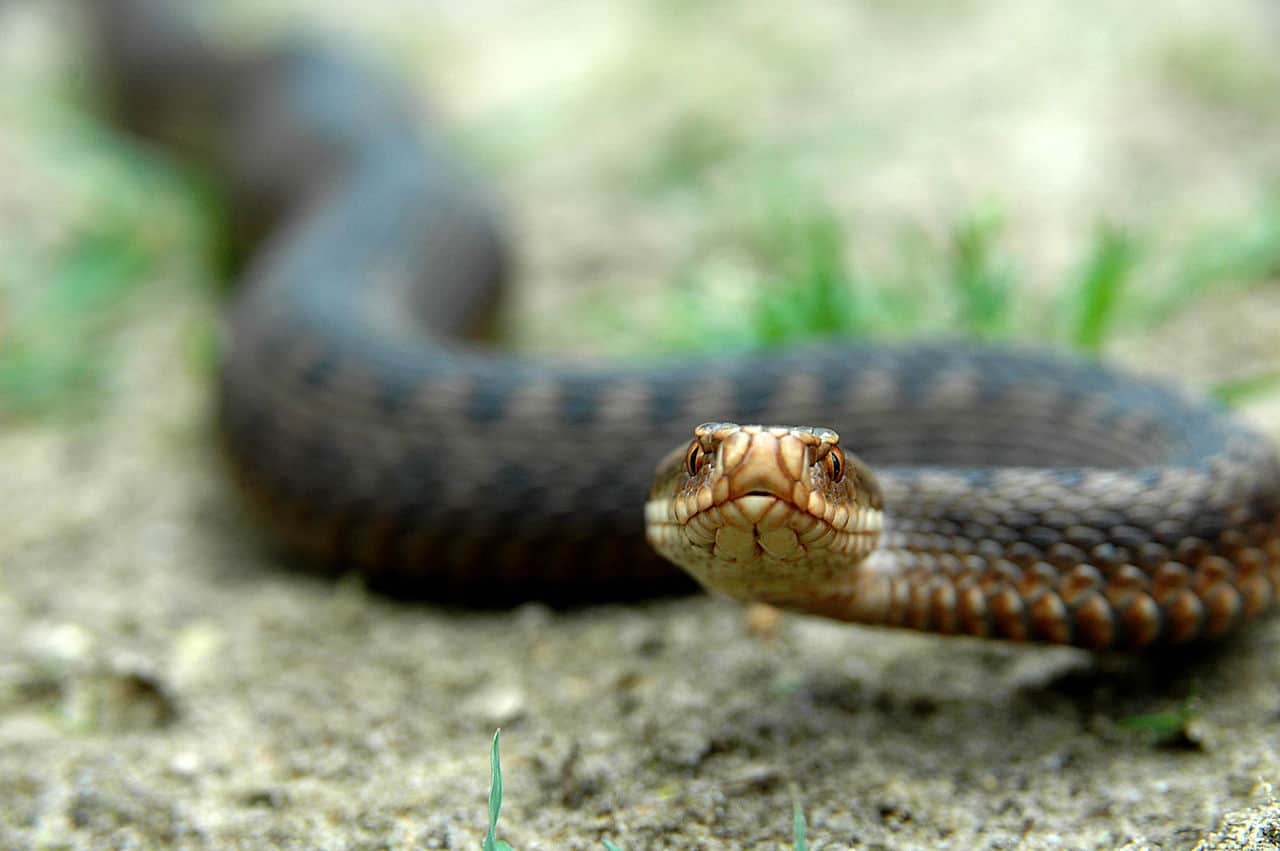
The adder is a viper species found in Europe, which is well known to virtually every English, Welsh and Scottish person as the only dangerously venomous snake on British soil. It’s a relatively small species, with an average length of 60cm (max 104cm), and is relatively thick-bodied, like many vipers. This species doesn’t appear in Ireland, but ranges from Cornwall in the far southwest of England to the chilly northern tip of Scotland.
The UK has 3 native snakes overall. The grass snake is abundant and completely harmless, and spends the majority of its life in grassy fields, ponds and small streams. The smooth snake is slightly venomous, and appears in heathland in only a few southern counties. Meanwhile, the adder is the only snake capable of killing, although deaths aren’t common, with the last UK fatality occurring in 1975.
Adders avoid urban habitats, appearing in woodlands, meadows, sandy heaths, rocky hillsides, golf courses, popular dog-walking commons and crumbling cliffs near beaches. They belong to the Vipera genus of true vipers, which has 21 members across Europe and North Africa, also including the nose-horned viper of Greece, and Lataste’s viper of Spain.
Virtually all British people are aware of the adder, but there’s one small fact which isn’t as well known: that this is the single most widespread venomous snake in the world.
| 2 | From Wales to North Korea |
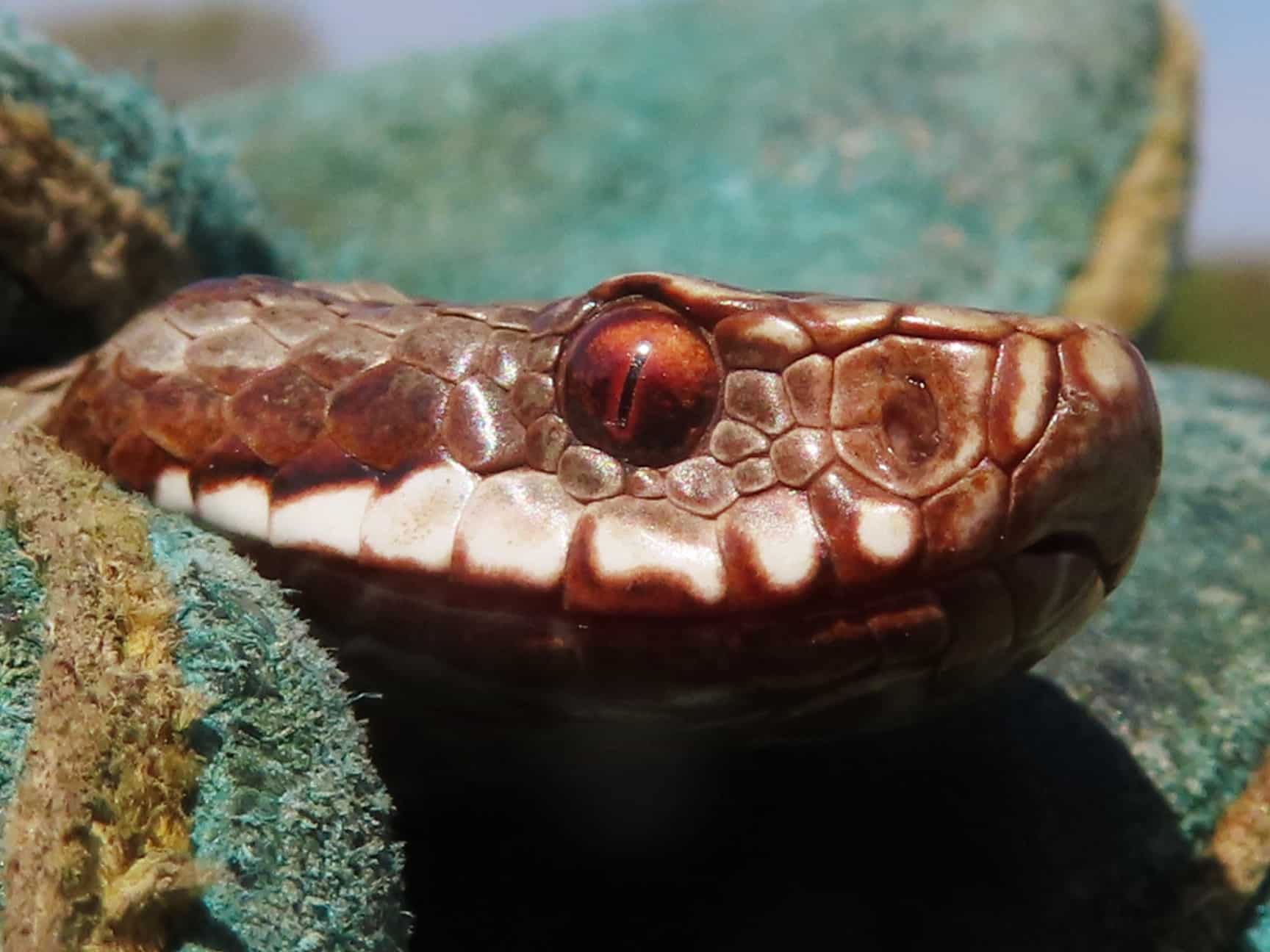
Great Britain is only a fraction of the adder’s gigantic empire, as this species has the largest west to east span of any snake on Earth. Its westernmost points lies in Cornwall (England) and Scotland, possibly on the scenic Isle Of Skye. Its easternmost point lies in Sakhalin, Russia, a remote island of brown bears and secretive military installations. The adder also inhabits North Korea, far northern China, Mongolia and most of southern Russia, far from the comfortable leafy shires of southern England.
In Europe, adders are found in northern France, Germany, far northern Italy, Poland, Ukraine, Finland, Norway, Sweden and western Russia. They’re not found in Spain and Portugal, as they generally have a northerly bias.
For example, France is divided in two, with the asp viper (Vipera aspis) controlling the lower two thirds of the country and the adder controlling the north. However, an exception is high altitude, as the Massif Central further south in France hosts an isolated adder colony.
Even extreme northern Turkey has a small adder population, on the southern shores of the Black Sea. Greece, Serbia, North Macedonia and Bulgaria host plenty of adders as well, alongside the closely related nose-horned viper.
| 3 | The frostiest of all snakes |
The adder holds many records, including one which stems from its exceptional tolerance to cold conditions. A cobra dropped into the highlands of Scotland would die within days, or most likely take shelter in a warm farmhouse somewhere, and get relocated to a zoo by the RSPCA after a phone call from the terrified owner. But adders can survive with ease, albeit hibernating for 6 months of the year, or even up to 8 months in Scandinavia.
This resilience has led to another record – the most northerly snake on Earth, out of 4000 species. The adder appears not just in southern Norway and Sweden, but the Arctic circle, moving through dense undergrowth in Lapland. The adders here are fully venomous and just as dangerous as ever.
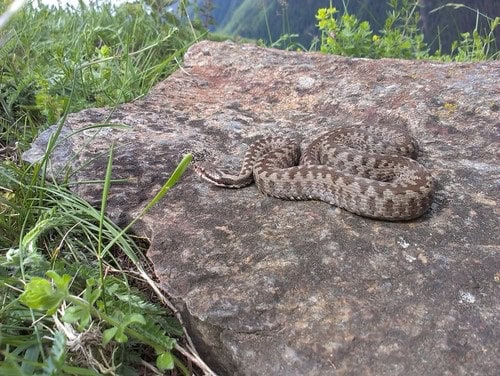
This cold tolerance applies vertically as well, as adders have been found in the Swiss alps at 3000 metres above sea level. These high altitude adders are commonly melanistic – fully black, due to an overexpression of melanin pigments, with the purpose of absorbing additional sunlight.
Such black adders are common in the Austrian and Italian alps as well. Adders have even been photographed moving over patches of snow, after briefly awakening from hibernation on unusually warm winter days.
| 4 | Recognise the adder: easy ID signs |
Adders are fairly easy to identify, and become easier considering their lack of neighbours in northern European countries. In the UK, but also in Denmark, Norway, Sweden and northern France, the only common snake the adder coexists with is the grass snake, a harmless pond dweller.
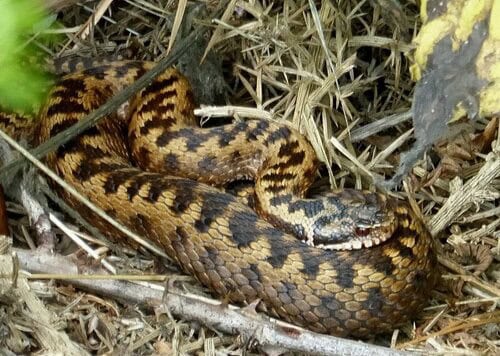
The first ID trick is the pupils, which are vertical in adders, like in most vipers, but round in the grass snake. This is difficult to observe if you’re scared about being bitten on the nose. However, the simplest ID trick is a large black zigzag down the adder’s spine, which is easily noticeable from several metres away.
Adders vary in colour, as females are often brown while males are typically greyish. However, this thick zigzag is virtually always present. Grass snakes instead have a series of thinner markings, and have a classic ID sign of their own: 4 or 5 black markings below the eye, almost like tear drops, contrasting against a greenish face.
The adder has a black marking near the eye, but this is a stripe stretching backwards horizontally instead. Grass snakes often have a pale neck collar as well, which adders completely lack.
The only tricky thing with adders is the melanistic variant, which erases the zigzag, but given that melanistic grass snakes are incredibly rare, and fully black adders aren’t, this becomes an ID sign in itself. Additionally, melanistic adders appear in areas where grass snakes are less likely to: northern Scandinavia and alpine forests.
| 5 | Bites in the UK |
Adders are survivable, but still potentially lethal. Between 1876 and 2005, there were only 14 deaths in the UK, and the last occurred in 1975, the victim being a 5 year old child.
More recent victims include a 44 year old man in 2014, who picked up an adder in Dalby Forest in northern Yorkshire. He was bitten three times, and ended up in hospital in a stable but serious condition. A 38 year old woman nearly died in Essex in 1999, and a dog called Toby was bitten on the face in 2018, when he ran into the undergrowth in Cavenham Heath, England. His faced swelled up like a balloon, but he survived.
In 2015, a 14 year old boy tumbled off a cliff in Cornwall and fractured his pelvis, after falling 100 feet. After calling his brother, he made an agonising climb back up, over jagged rocks, but things soon turned from bad to worse when a lurking adder hissed and bit his arm, which swelled to three times its normal size. His mother heard the rescue helicopter overhead and had no idea her son was the victim.
Another beach incident took place in 2026 in Cornwall, when an adder was “rescued” from Portheras Cove, a popular tourist spot. A bird of prey was theorised to have dropped its meal, or the adder may have tumbled off a cliff. Nobody questioned whether the adder was in fact enjoying its beachside escape.
| 6 | Longer in Scandinavia |
Female adders are slightly longer than males, at 60-65cm versus 50-55cm. 70cm is normal for a large female. But that’s only in the more temperate parts of Europe. Grab your hiking staff, travel north, and exit the civilised realm of Denmark, and the rules change entirely, for you have now entered the realm of giant adders.
A 2021 report focussed specifically on huge adders from Scandinavia. The first had been frozen in a man’s freezer for 13 years without taking measurements. The man had discovered a roadkill female adder, near Lake Årungen 25km south of Oslo, near an area of forest and arable land. This was in 2007, and in 2020, the adder was finally measured at 93.5cm, including a 10.2cm tail.
Like many Scandinavian adders, this snake was melanistic, with no visible zigzag pattern. The report documented a 78.5cm adder as well, found 50km south of Oslo, a male which had been seen frequenting the area for years.
The longest adder of all time was also reported in Scandinavia, a showstopper measuring 104cm. This was found in Härjedalen, central Sweden in August 1914. According to rumour, some of the most enormous adders are found east of Kiruna, Sweden’s northernmost city, located 150 miles north of the Arctic circle.
| 7 | Diet of the adder (adults) |

The adder derives most of its meals from mammals, but is highly adaptable and able to switch to new foodstuffs depending on location. These mammal-eating tendencies were proven overwhelmingly in a study released in 1991.
From 1987 to 1989, the authors researched two areas in the northern Italian alps. The first was located near Fedaia Pass at 2200-2500 metres, and was an alpine pasture near a wooded zone. The second was much lower, at around 1100 metres, and consisted of mountain pinewoods mixed with bushes and old stone walls and ruins.
At the first site they discovered 23 meals from 64 adders, of which 78.3% were mammals. At the second site, they analysed 96 adders, and produced 32 meals. The result was 96.1% mammals.
Other meals included a frog at site B, and several nestling birds at site A. The mammal theme was consistent, yet the precise form varied. At site A, the adders preyed heavily on the European snow vole (Chionomys nivalis), accounting for 69.6% meals, alongside two alpine shrews (Sorex alpinus). At site B, the favourite foodstuff was field mice (Apodemus genus), at 43.8% of meals, followed by the European pine vole (Microtus subterraneus) at 25% of meals.
| 8 | Newborn diets: salamanders and baby mice |

The study above focussed on adult adders, as it only included snakes longer than 34cm. But a 1995 study included adders measuring 16-35cm, attempting to analyse the diets of juveniles. The study was again from the Italian alps and included two locations: site A, a grassy pasture near a coniferous forest, and site B, a stony area near mountain pines.
This time, there was a vast difference between the two locations, showing how adaptable this snake is, and partly explaining how it’s conquered the biggest stretch of Eurasia since Genghis Khan (although it was actually there millions of years before him). The scientists observed a proliferation of newborn rodents at site A, and consequently, mammals accounted for 73% of meals there. The favourite meal group was newborn Apodemus field mice, at 32 meals, followed by the viviparous lizard at 9 meals. 52 meals were found overall, from 37 adders.
Site B was radically different, as the adders were heavily dependent on the alpine salamander, accounting for just under 50% of meals. This black, tiny, slow-moving salamander is easy to catch, and is highly abundant in certain alpine areas. The adders were found to be catching them amid the twisting roots of the mountain pines. 81 meals were found at site B from 65 different adders.
At site A, no alpine salamander meals were recorded. Also recorded at site B were viviparous lizards (11) and Apodemus field mice (11). However, mammals accounted for just 13.6% of juvenile meals, a massive deviation from site A.
| 9 | Dangerous, but tiny venom yield |
The adder has a decently powerful venom, but there’s a restrictive wall which it can never quite break through: its low venom yield. Estimates vary, but the adder produces only 6-18mg per bite, depending on the size of the snake. This is dwarfed by the black mamba at up to 400mg, the king cobra at 500mg, and the timber rattlesnake at 75mg+. The venom itself isn’t massively powerful, as one study found that 40-67mg was required to kill a guinea pig versus 1.7mg for the Russell’s viper.
That said, the adder should never be underestimated. This species generally lacks neurotoxic powers, except in a few rare individuals; it has little power against brain signals, causing no respiratory distress, twitching eyelids, weak muscles, and definitely not paralysis.
Instead, the adder specialises in haemotoxic and cytotoxic symptoms. Common manifestations in humans include nausea, sweating, fever, lightheadedness. The signature symptom is swelling, which can spread to affect the entire arm, or maybe leg, if an adder strikes your toes between your sandals on a beach (very possible).
| 10 | Newborns are instantly dangerous |
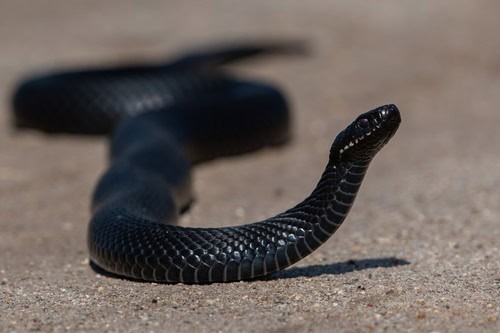
Adders lay live young rather than eggs, like the majority of vipers worldwide, with one exception being the egg-laying night adders of Africa (Causus genus). The range is 3-20 young, which are born in clear sacs, breaking free within minutes. Adders are venomous from birth and have an average day 1 length of 17cm, but can be as small as 14cm.
The most maternal snakes on Earth are rattlesnakes, particularly the Arizona black rattlesnake, where females will actually guard the offspring of nearby mothers when they leave rock cracks to hunt. Adders aren’t that maternal, but will remain with their young for a few days post birth. Newborns perform their first skin shed within one day of birth.
As for father adders, they don’t care about their offspring one bit. But they do care about the mothers, or at least pursuing them: male adders can follow the scent trails of females for hundreds of metres per day.
Wrestling has been recorded as well, as two males raise their upper bodies, and attempt to repel each other through brute force. These contests are true wrestling bouts, as no biting has ever been recorded.
| 11 | How to accidentally meet an adder |
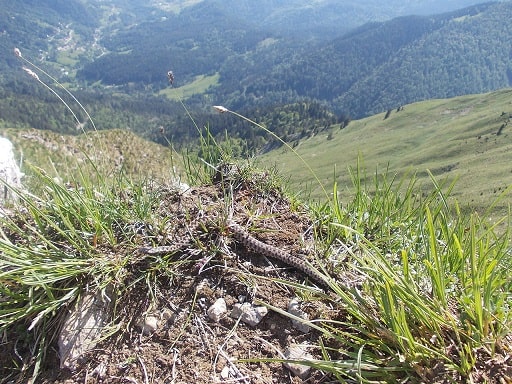
If you stay within the comfortable confines of London, or Berlin, or Oslo, you can stay safe from the adder and its glaring vertical pupils. But one day, you may have to venture out into the dark, gloomy countryside, with its lengthening shadows, menacing ravens, and tree branches that seem permanently bare of leaves. You may meet the adder, in one of these possible locations:
On a beach – adders dislike concrete and tarmac, but they have no issue with sand whatsoever. They can appear on the shifting sands themselves, not far from the salty sea, or on piles of jumbled rocks accumulating below a cliff.
On a golf course – the mixture of open fairways and greens, and clumps of trees, and tangled bushy rough, is probably the best habitat for an adder that mankind has created.
In the alps – a summer hiking holiday to Austria or Switzerland could end with an adder biting your leg, or perhaps striking harmlessly if terrifyingly against your thick walking boots. This could happen within minutes of disembarking a gondola or chairlift at around 2000 metres.
While dog-walking – adders appear in woodlands and on open commons, scenic areas where people may walk their dogs every day, without ever becoming aware of their venomous neighbours, until a sudden pair of fangs strikes their ankle, or misses by millimetres as they perform a heroic leg withdrawal at the last second.