
| 1 | A stealthy coral snake mimic |
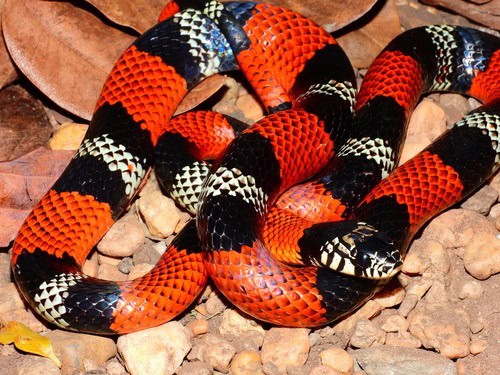
The Aesculapian false coral snake (Erythrolamprus aesculapii) is a species found in South America, in countries such as Brazil, Ecuador, Colombia, Guyana and Venezuela. It’s a moderate length species, with a maximum size of just over 1 metre (103.6cm), and a body length of average thickness. In appearance, this species doesn’t stand out in any way, but that’s the entire point, for this snake’s main survival strategy is mimicry – copying the various neurotoxic coral snakes of South America.
Across the Americas, there are 82 coral snakes of the Micrurus genus. All are potentially lethal, paralysing their victims and typically killing via respiratory failure. This has led to legions of mimics appearing, such as milk snakes and flame snakes, and the Aesculapian false coral snake is one of the most successful.
This species features the following patterns – red-black-white-black-red, repeated endlessly. Its face is a mixture of white and black, sometimes with a yellow neck band. Another ID sign is a slight black edge to each red and white scale, giving it an appearance of black speckles.
Dozens of coral snakes have these colours, and this is enough to keep the Aesculapian false coral snake safe from villagers, scientists and predatory birds alike. This snake has a venom of its own as well, but this is only mild to moderate in intensity, and never lethal in humans. Mimicry is its main survival skill, and at first glance, it’s very difficult to distinguish from its deadly neighbours.
| 2 | Common in South America |
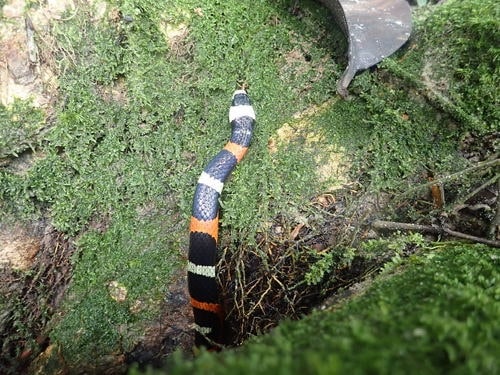
Aesculapian false coral snakes cover virtually the entire Amazon region, and are highly flexible in their habitats. They’re abundant in rainforests, but also appear in villages and pastures nearby, with decent tolerance for deforestation, agriculture, and other forms of human interference. When lumberjacks slash down forests, some snakes disappear completely, but the Aesculapian false coral snake is hardy enough to survive.
Erythrolamprus aesculapii has no presence in Central America. In the northwest, it reaches as far as Venezuela and eastern Colombia. It’s highly abundant in eastern Peru and Ecuador, but not the west, and covers northern territories like Guyana, French Guiana, and Suriname. Away from the Amazon, it’s extremely common along Brazil’s southeast coast, including near Rio de Janeiro. Aesculapian false coral snakes also appear in Bolivia, Paraguay, and extreme northeast Argentina.
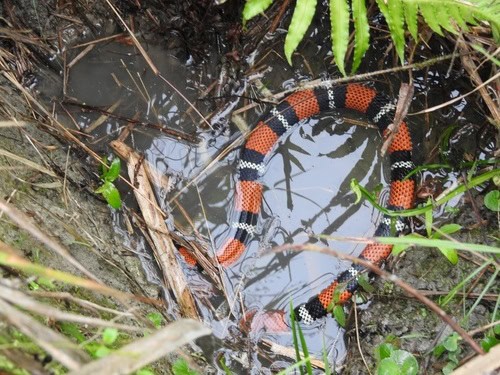
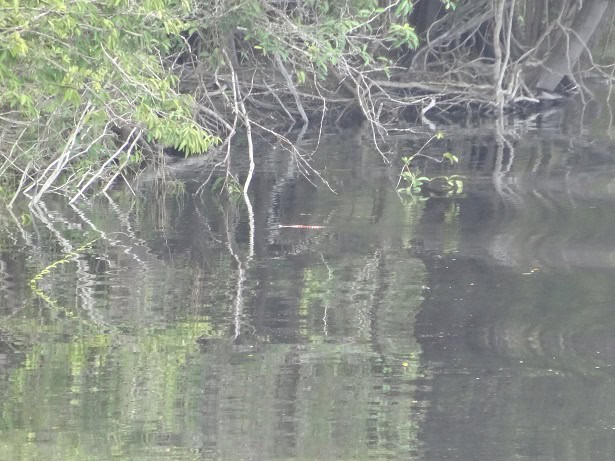
This species climbs trees occasionally, but is nearly always found on the ground, moving over mossy boulders or hundreds of leaves and twigs coating the forest floor. It’s a strong swimmer as well, crossing marshes and rainforest rivers with ease. It can enter burrows, but lacks any particular burrowing skills.
| 3 | Venom: proven bites in humans |
Aesculapian false coral snakes aren’t just mimics, as they possess their own venom, but the two case reports we have so far suggest moderate effects at best.
The first took place in São Paulo state, Brazil, in November 2016. The victim was a male herpetologist 1.75 metres tall and weighing 80kg. While handling the Aesculapian false coral snake, it sank its teeth into his finger. The problem: he left it attached for a full minute. This was bad news for him, but good news for science, as it produced the first ever detailed report of the species’ bite.
It took 5 minutes for his finger to begin swelling painfully. Within 1 hour, his hand was fully swollen, and within 4 hours, swelling had spread to the wrist and forearm. This was accompanied by a painful blister.
The next day, the swelling reached his elbow, and a purple bruise covered his finger. Two days post bite, the swelling was subsiding but still covered half the length of the arm. The blisters were still in place, and there was leftover paraesthesia (tingling).
Over the next week, the symptoms gradually subsided, and the man was left with no lasting symptoms. He took no antivenom (as no antivenom exists), but did pop a couple of antihistamines on the first day.
| 4 | No deaths are known |
The second bite case took place in Cochabamba municipality, Bolivia. It was October 2022, and a male villager 1.7 metres tall had taken rest against a piece of fallen timber. Suddenly, he felt a piercing pain in the back of his neck. He had disturbed a resting Aesculapian false coral snake, which was possibly using the log as a shelter.
This time, the bite lasted just 3 seconds, but symptoms appeared only 10 minutes later. The man (who was aged 35) began to experience fatigue, fever, shortness of breath, and moderate swelling of the head and neck. His eyes and nose began to itch and redden painfully.
The man refused treatment, and instead took a local remedy for snakebites: 200ml of 96% concentration ethanol. This failed to mitigate the symptoms, and even worsened them. The man gave in to the researchers’ pleading and was injected with corticosteroids, but then left the scene an hour later. The next day he returned, but had mostly recovered.
This Bolivian report backed up the one from Brazil: capable of minor chaos, but not killing.
| 5 | Specialises in haemorrhaging |
A 2019 study found an odd fang shape in this species. Unlike a cobra, Erythrolamprus aesculapii is rear-fanged, meaning that it must chew its venom into victims over several minutes. The study found that this species’ fangs had a double-curved structure, with sharpened edges on the front and back. This was complimented by a deep groove running down each fang, probably to act as a channel to funnel the released venom into victims.
The venom itself was analysed as well, and had high proteolytic activity, dissolving collagen and casein cells in a lab. This could also apply to the collagen found in human skin. The venom destroyed another component of human skin as well – hyaluronic acid, a structural competent popular in skincare creams. Another substance dissolved was fibrinogen, the backbone of blood clotting.
The scientists tested the venom’s lethal potency in mice, and the lab animals rapidly became drowsy and lethargic. Post-death, autopsy revealed significant internal haemorrhaging, which was most concentrated in the lungs. Haemorrhaging was also tested directly, and Erythrolamprus aesculapii was found to be relatively potent.
Despite those menacing qualities, Erythrolamprus aesculapii couldn’t compete with the most dangerous snakes of South America. Its haemorrhagic skills were beaten 14-fold by the jararaca (southeast Brazil), and its lethal potency in mice was beaten 10-fold by the Argentine coral snake. Small rodents are one question, fruit pickers and fishermen are another.
| 6 | Secret ID signs |
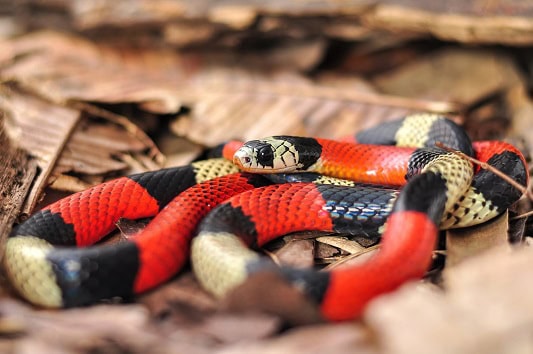
Dozens of coral snakes in South American are red, white/yellow and black, but the Aesculapian false coral snake has a couple of strong, if not quite foolproof ID signs.
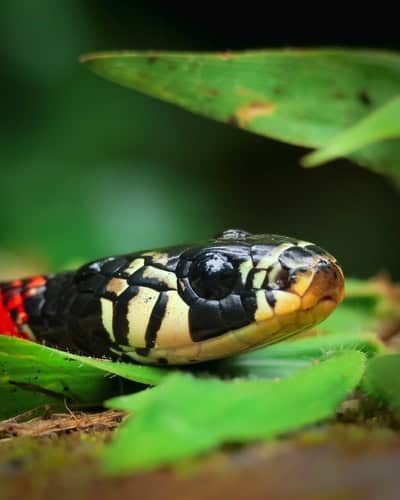
The first is the eyes. Among venomous snake groups on Earth, coral snakes have particularly small eyes, from the painted coral snake of southeast Brazil to the aquatic coral snake of the Amazon. The Aesculapian false coral snake’s are significantly larger, although there’s one tricky roadblock: its eyes are often surrounded by black scales (see above), making them tricky to distinguish. This applies to coral snakes as well. Both have round pupils rather than vertical.
Secondly, the Aesculapian false coral snake’s exact band positioning is matched by virtually no coral snake in South America. The likes of southern coral snakes (Brazil) and aquatic coral snakes have red bands touching black, followed by white. But few have a dyad pattern – red followed by black, white, black and red again like Erythrolamprus aesculapii.
The majority of red touching black coral snakes in South America have a triad pattern, where the black is repeated three times and the white twice before the red kicks in again. Erythrolamprus aesculapii is a variable species, but the dyad pattern is mostly consistent.
Remember – the Aesculapian false coral snake’s patterns go red-black-white-black-red in the majority of individuals. The black repeats twice and the white once in each pattern loop.
| 7 | Survival tactics |
Aesculapian false coral snakes are non-lethal, but they’re also extremely unpredictable, with a huge number of moves in their defensive repertoire.
The 1st is their mimicry shield, and the 2nd is fleeing into the undergrowth, never to be seen again. But they also have the following skills at their disposal: dorsoventral flattening, head hiding, head triangulation, releasing a vile smell, showing their bright tail, poking with their tail, rotating, and sudden unpredictable movements.
Head triangulation is particularly useful, with the goal of mimicking a dangerous viper. Dorsoventral flattening is like a cobra; enlarging the upper body sideways. All these behaviours were recorded in a single study from 2019, where 10 living Aesculapian false coral snakes were collected in Minais Gerais state, Brazil.
The final phase of the plan is actual aggression. Aesculapian false coral snakes sometimes raise their body as though preparing to strike, and they sometimes make bluff strikes. But unlike other non-lethal strikes, they also progress beyond warnings and make genuine strikes.
| 8 | Diet: 90% other snakes |
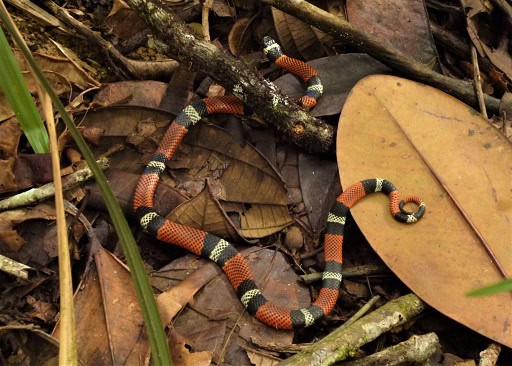
The Aesculapian false coral snake has a highly specialised diet: other snakes, which contribute the vast majority of its meals. In fact, this species has the highest amount of confirmed snake meals of any snake in South America, alongside the mussurana, AKA Clelia clelia. Worldwide, it sits alongside the king cobra as an ultra-prolific snake eater.
A 2022 study compiled all available diet records of the Aesculapian false coral snake, and found one new species. 36/40 meals, or 90%, were fellow snakes. Also found were two eels and two swamp eels. No frogs or mammals were recorded.
Unlike the mussurana, which is infamous for taking down venomous snakes, with full venom resistance flowing through its bloodstream, Erythrolamprus aesculapii tends to focus on harmless snakes. No vipers were found among the 36 meals, and only 1 coral snake. Its tactic is to seize hold of its snake meal and slowly chew its moderately strong venom in. Unlike most other snake-eating snakes, this species swallows its meals by the tail.
| 9 | Confirmed snake meals (no vipers) |
Here’s just a sample of confirmed snake meals:
Blunt-headed tree snake – one of the thinnest snakes in South America relative to length. Lives in trees and has a mild venom. This prey was discovered in the study above, and was found with 50% of its body down the false coral snake’s throat.
Coral snake – one unidentified species was found.
Guibe’s flame snake – recorded 3 times in its diet. Another coral snake mimic, with a mild venom. Widespread in southeast Brazil.
Black-headed snake – one of the most popular snake prey in South America. A tiny (30cm) species which is completely harmless, but incredibly widespread. Recorded twice as prey.
Snail-eaters – Dipsas is a snake genus called the snake-eaters, which derive their calories from snails and slugs. They’re completely harmless and defenceless, and 4 separate species were found in the Aesculapian false coral snake’s diet. An unidentified species was found as well.
Ground snakes – this was beaten by the Atractus genus, the ground snakes, another completely harmless group. 5 confirmed Atractus species were recorded in the Aesculapian false coral snake’s diet, making this genus its most popular prey type.
Erythrolamprus – the same genus that the Aesculapian false coral snake belongs to. 5 separate Erythrolamprus species were recorded, tying with the Atractus genus. One was the military ground snake, recorded twice as prey. This species is mildly to moderately venomous, but never fatal in humans.
Annulated cat-eyed snake – a thin-bodied tree dweller which preys on frog spawn, and appears all over South America.
| 10 | Giant meals, but a patient swallower |
The Aesculapian false coral snake is diurnal, moving by day. Scientists theorise that it deliberately ambushes sleeping snake prey, as the blunt-headed tree snake is a nocturnal snake, which rests during the day on branch perches 0.5-4 metres high.
This species is capable of eating huge meals as well. One report came in June 2008 from Minas Gerais state, Brazil. The victim was a yellow-bellied liophis (Erythrolamprus poecilogyrus), regurgitated by a false coral snake near a lake. This snake measured 80.3cm and weighed 85 grams, easily exceeding the size of the false coral snake, at 71.1cm and 56 grams. This made for a predator to prey mass of 152%, one of the largest ever recorded in a snake.
Aesculapian false coral snakes are relatively patient eaters. They don’t gulp down their meals and slither off in a mad dash (like the coachwhip), as a false coral snake from Amapá state, Brazil took 50 minutes to swallow a Boie’s ground snake, a harmless species.
| 11 | Varies in appearance |
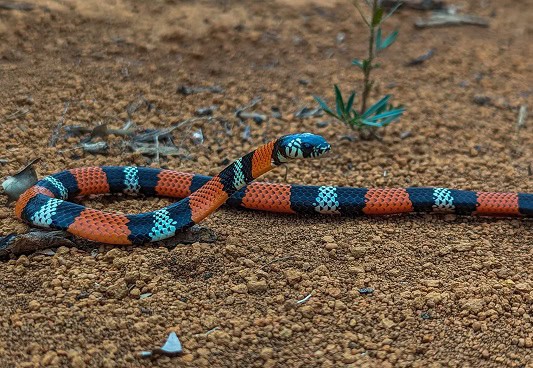
The image above is standard for the Aesculapian false coral snake, but this species has significant variation as well, which could leave you dazed and confused in the middle of the rainforest (and possibly swallowed by an anaconda seconds later).
The overall pattern of red-black-white-black-white is usually consistent (except in southeast Brazil). However, the length of the spaces varies. Red is generally the longest, but in some it becomes more equal with the black and white, resulting in a totally different appearance. Some have less prominent black speckles over the red and white.
Another tendency is a bright yellow band on the neck in some individuals, which is totally lacking in the individual above. Supposedly, this yellow band is particularly common in Ecuador, and more common in juveniles. Occasionally, you’ll find weird morphs, like this Ecuadorian version which has almost no red at all. A similar morph was found in Suriname, with a bright orange belly.