| 1 | Wagler’s pitviper |
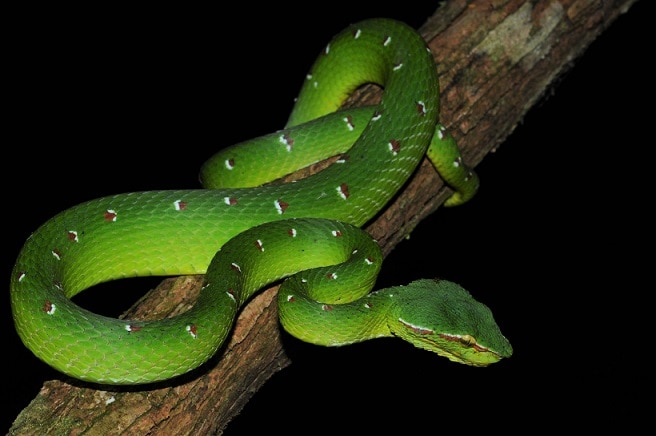
Maximum length: 130cm.
The most common venomous snake in Singapore. This species appears across virtually the entire island. It’s most abundant in the scenic nature reserves of central Singapore, e.g. Windsor Nature Park and Upper Peirce Reservoir Park. But it also appears in leafy streets, suburbs and housing estates, appearing from nowhere to shock local residents. All it needs are remnant patches of trees and bushes, still surviving after the construction of houses.
Wagler’s pitviper is a branch-dwelling snake. It’s also found in southern Thailand, peninsular Malaysia and Sumatra, but Singapore has the highest density of sightings of all. While cobras mostly slither along the ground, this species is more likely to strike from a branch. Consequently, a study found that 56.6% of Wagler’s pitviper bites struck the upper limb.
This species is dangerous, but unlikely to be lethal. It’s one of the few neurotoxic vipers worldwide, with a toxin called waglerin-1 which behaves similarly to the alpha-neurotoxins of black mamba venom.
However, while the effect is similar, these toxins are relatively weak. Rather than paralysis, human victims generally experience tingling (paraesthesia) across the body. 27.2% of victims experienced swelling in one study, which is low for a viper. No deaths are known from this species, but a hospital visit is always recommended.
PS: Wagler’s pitvipers differ wildly between the genders. Males are green with red/white spots like above, while females are a neon yellow/black, and far larger than males too.
| 2 | Equatorial spitting cobra |
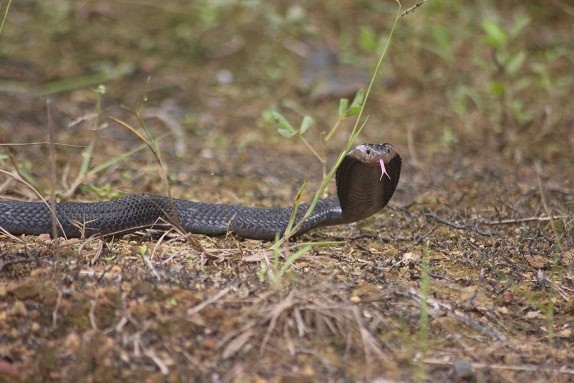
Maximum length: 150cm.
Wagler’s pitviper is relatively mild even for a viper, but this snake is a much more cunning and deadly foe. The equatorial spitting cobra (Naja sumatrana) is the most widespread cobra in Singapore, covering virtually all the main island, although it doesn’t appear on Jurong Island to the southwest. Equatorial spitting cobras have a black appearance, with a thin body, and a nervous, energetic demeanor.
This cobra has a neurotoxic and myotoxic venom, inhibiting brain signals and damaging muscle tissue. According to a 2022 study which compared the two, its venom was slightly less lethal than that of the monocled cobra, Thailand’s main cobra. However, this species has the ability to spit venom, producing two thin clear jets of venom, one from each fang. It aims for the eyes, attempting to blind victims.
Equatorial spitting cobras have a tendency to invade houses and even bedrooms as well. Wagler’s pitviper is fairly safe to observe from a distance, through you should always be cautious. But equatorial spitting cobras are the opposite, with a long range weapon which can leave you without vision for several days. This is easily the 2nd most widespread venomous snake in Singapore.
| 3 | Mangrove pitviper |
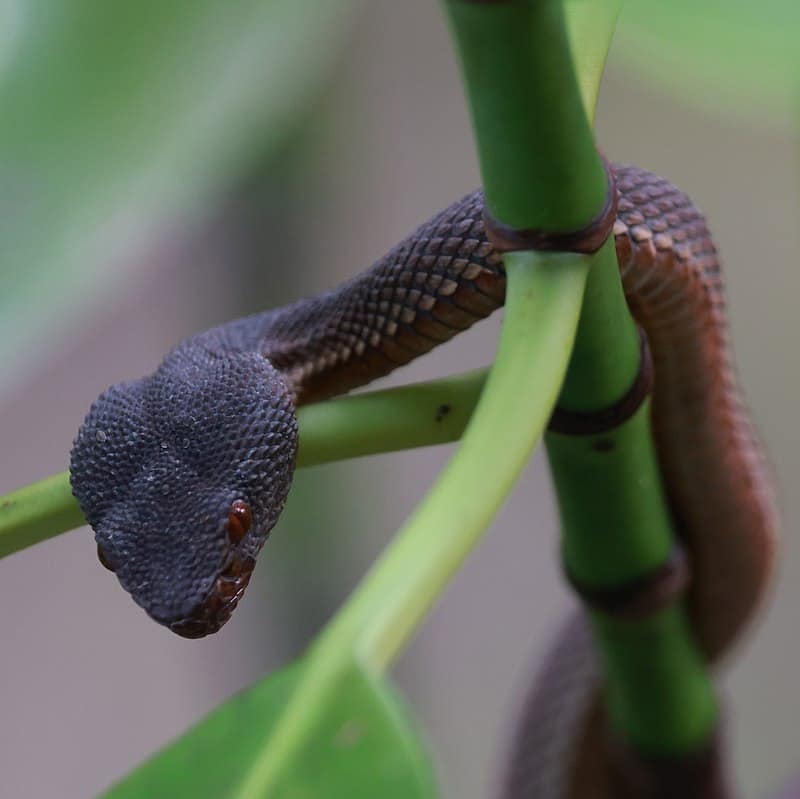
Maximum length: 107cm.
Another branch-dwelling pitviper, but an easily recognisable one, due to its darker scales. This species has no green scales whatsoever, in males or females, and has a sharply triangular head.
Mangrove pitvipers are less widespread than our first two for a simple reason: they always appear near water bodies. They can’t appear on dry land within a forest, but with plenty of lakes and mangroves in Singapore, there’s still plenty of habitat for mangrove pitvipers to settle down in and begin their life’s work of terrifying people. Mangrove pitvipers often live in gloomy, swampy areas, which makes them particularly eerie when combined with their shadowy black scales.
As for their venom, it’s rarely fatal, but specialises in severe swelling and haemorrhaging. One male victim experienced progressive swelling for 12 hours, which passed the elbow. Another man’s swelling continued to progress for 11 days, after which it finally reached the upper arm.
However, no deaths are currently known from this menacing species. Two particular hotspots in Singapore are the Pasir Ris Park in the northeast and Sungei Buloh Wetland Reserve in the far north.
| 4 | King cobra |
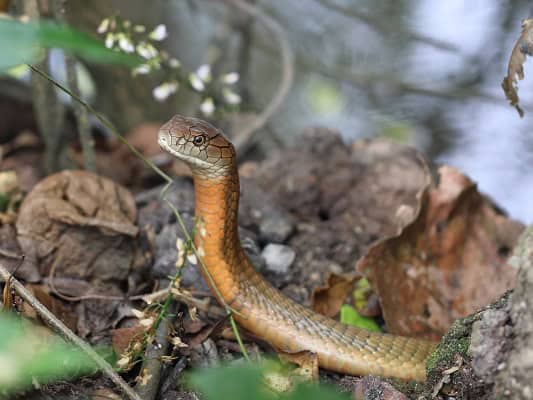
Maximum length: 5.85 metres.
The infamous king cobra covers a decent swathe of land in Singapore, though far less than the equatorial spitting cobra. King cobras are less comfortable in manmade areas, in suburban streets or bushy overgrown alleys. However, they’re plentiful in most of Singapore’s nature reserves, including Sungei Buloh, Windsor Nature Park and Upper and Lower Peirce Reservoir Parks.
This species is easy to differentiate with a few tips. Firstly, king cobras are much longer than equatorial spitting cobras. Secondly, they have a more golden, beige appearance, rather than pure black. A similarity is the classic neck flare, enlarged sideways as they rear up and attempt to intimidate you. A few diet observations have been made in Singapore, including cannibalism, a clouded monitor meal, and a reticulated python meal.
Until 2024, the king cobra was a single species, but that year, it was split into 4 separate species. The colonies in Singapore now belong to the Sunda king cobra (Ophiophagus bungarus), whereas those in central Thailand belong to the northern king cobra, the most common species. In diet and appearance, the species are identical, but it’s possible, even likely that subtle venom differences will be discovered one day.
Either way, your goal is the same: give the king cobra no reason to dislike you. This species has highly toxic venom, and injects vast quantities due to its brutish body size. This is easily the longest venomous snake in Singapore.
| 5 | Malaysian blue coral snake |

Maximum length: 185m.
The most dazzling colourful venomous snake in Singapore, but also the most insidiously lethal. This species is confirmed to kill, and confirmed to kill in Singapore. One of the few deaths involved a showering man in 1985, from Singapore, who was bitten on the foot by a blue coral snake. He died only 5 minutes later.
The Malaysian blue coral snake (Calliophis bivirgatus) is found in southern Thailand, peninsular Malaysia, and Singapore, where it appears mainly on forest floors. It prefers pristine areas but can appear in villages and houses, as the death of the man shows. This species has a blue body and a red head, with round black eyes. It should never be touched in any circumstances, as it has some of the more unusual venom qualities on Earth.
Firstly, the Malaysian blue coral snake has enormous venom glands, stretching an entire third of the way down its body. Secondly, it contains a unique toxin: calliotoxin, which causes paralysis not by the traditional black mamba method of blocking acetylcholine receptors, but overexciting the sodium channels of cells across the body. This leads to a complete shutdown of brain signals, which can occur in just minutes.
Malaysian blue coral snakes are most common in Singapore’s central reserves, but appear in more scattered colonies in forested areas across the island. They almost never appear on branches, sticking to the forest floor.
| 6 | Banded Malaysian coral snake |
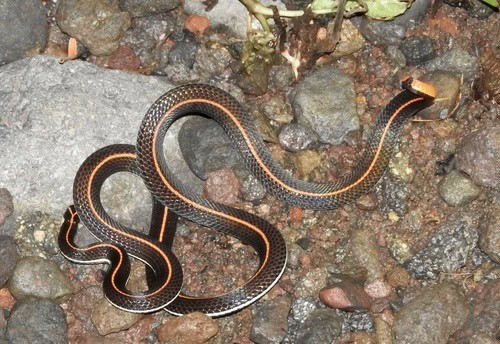
Maximum length: 71cm.
Another member of the Calliophis clan, and slightly less common across Singapore. The banded Malaysian coral snake (Calliophis intestinalis) is similar in many ways, as it prefers cluttered forest floors as well, and is common in the nature reserves of central Singapore, such as Windsor Nature Park, with occasional appearances in pristine areas elsewhere.
This species is much less colourful, with less blue and red, but is still easily recognisable. Its ID signs include a thin, orange stripe down the spine, with additional pale stripes on each flank, both very thin. Banded Malaysian coral snakes seem to be less lethal than their cousin, but still should never be underestimated.
One bite happened in 1937, when herpetologist Edward Jacobson was bitten by a captive. Over the next 6 hours, he experienced repeated waves of nausea, sweating, dizziness and breathing difficulties, before the waves gradually subsided. Breathing difficulties are a classic neurotoxic symptom, so it’s possible that this species could kill as well. One fact we know is that its venom is yellow.
Until this Singaporean species is more heavily researched, stand back, and let its lethal powers remain a mystery for now.
| 7 | Blue-necked keelback |
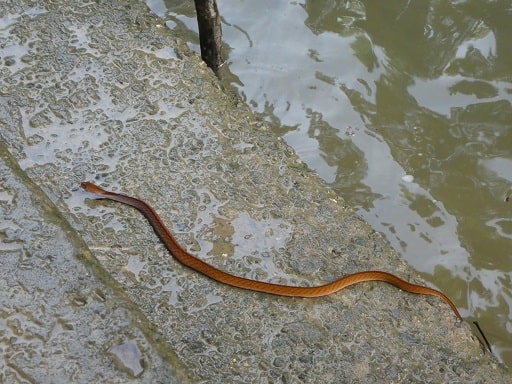
Maximum length: 75cm.
The Rhabdophis keelback genus is a snake group which was severely underestimated over the years, and this is the main member found in Singapore. The blue-necked keelback (Rhabdophis rhodomelas) is a forest floor species which has never killed anyone on record, but is known to cause slurred speech, muscular weakness, laboured breathing and faintness.
Singapore has many 50-70cm snakes which dwell on forest floors. Here are the ID signs for this species: 1) a bright autumn brown colour, 2) a dark brown or black stripe down the spine, 3) no significant patterns on the sides, 4) a paler neck, which is only very light blue rather than deep electric blue. The namesake neck isn’t particularly impressive, but has a dangerous purpose: storing toad toxins, acquired through its diet, which it bursts in people’s faces. This makes it a doubly dangerous venomous snake of Singapore.
In southeast Asia, the red-necked keelback and tiger keelback also have this ability, but neither are found in Singapore. The blue-necked keelback is the only Rhabdophis keelback member to live here.
This species moves at a moderate speed rather than dashing around, and bites are rare in humans. The biggest risk is manhandling this snake, so observe and resist the urge to scoop one up for a photograph.
| 8 | Banded sea krait |
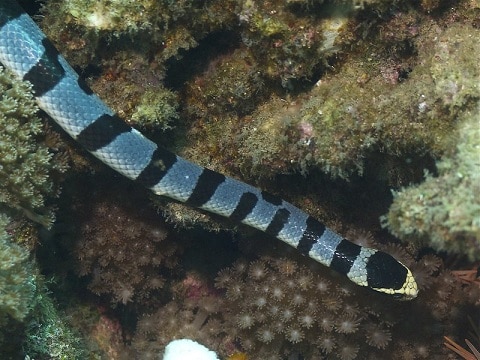
Maximum length: 152.5cm.
Singapore is located in the heart of southeast Asia, which is also the heart of the sea snake empire. The most common species on Singaporean shores is the banded sea krait, part of the Laticauda genus (8 members), which split their time between the sea, where they hunt for eels, and the rocky shores, where they rest and digest.
This species has the ability to kill, as one confirmed victim was a 23 year old man sailing off the north coast of Australia in October 2018. But whether it has the will is another question. The biggest risk is scooping one up in a fishing net. But swimming past a banded sea krait in a scuba diving wetsuit almost never results in a bite; it’s physical contact that triggers the aggression.
This species is easy to recognise up close, with a black and white banded appearance, contrasting against a yellow face. Another of its names is the yellow-lipped sea krait. Its venom is heavily neurotoxic, with higher toxicity than a king cobra, at an LD50 toxicity rating of 0.4mg versus 0.8mg.
| 9 | Banded krait |
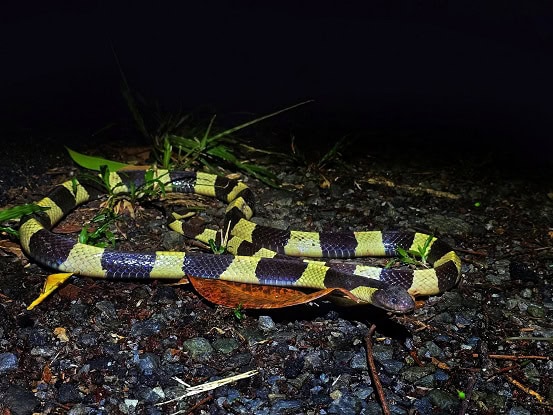
Maximum length: 212.5cm.
If you bump into a Wagler’s pitviper in the woods and phone a herpetologist, they’ll just shrug their shoulders. If you meet a banded krait in Singapore’s forests and phone a herpetologist, they may turn up at your front door and interrogate you.
Across southeast Asia, this neurotoxic species is very common. It’s the most common of the Bungarus krait genus (18 members) it belongs to, spreading from India through Thailand to Indonesia.
Singapore lies roughly in the middle of this empire, yet somehow, the banded krait barely has a presence here. Nevertheless, it is known to exist, just in very small numbers. Banded kraits dwell in forests, rarely climbing trees, sticking to the forest floor and occasionally sheltering in burrows. Their bright yellow and black bands should help them to stick out, yet they’re still sighted extremely rarely.
If you meet a banded krait, never touch it; its venom is extremely powerful and able to kill human beings via respiratory failure. This species preys heavily on fellow snakes such as sunbeam snakes, and can exceed 2 metres. It’s nocturnal, and much more aggressive at night, whereas by day it tends to be sluggish, and less likely to attack.
The one exception to this species’ rareness in Singapore is Pulau Ubin. This island lies in the extreme northeast and is the most rural, untouched area of Singapore. Sightings here are far more common than on Singapore’s main island.
| 10 | Spine-bellied sea snake |

Maximum length: 110cm.
The other sea snake you might meet in Singapore’s waters, if you can dodge the nurse sharks and bamboo sharks swimming round. Shaw’s sea snake (Hydrophis curtus) is a venomous species which has caused confirmed human deaths. It’s most common along the Indian coast, but appears near Myanmar, peninsular Malaysia and Thailand as well. Near Singapore, it’s extremely rare, but sightings are made very occasionally.
Compared to the banded sea krait, this species has a thick body, looser, crinkly-looking scales, and less sharply contrasting body bands. A 2017 study found an abundance of neurotoxins, including both long chain and short chain neurotoxins, which varied in abundance between January and June.
Another characteristic of Shaw’s sea snake is an extreme density of blood vessels in its head. When scientists attempted to make an incision with a scalpel, it triggered such heavy bleeding that they were forced to abort. This is theorised to be for delivering extra oxygen to the snake’s brain, for enhanced underwater survival.
Shaw’s sea snakes have a flexible diet, eating a variety of fish, unlike the eel-heavy diet of the banded sea krait. This is one of the most widespread of all sea snakes, and its flexibility might be why. Yet it’s still sparse in certain locations in the very core of its empire, and Singapore is one.