
| 1 | A sand rummaging snake |
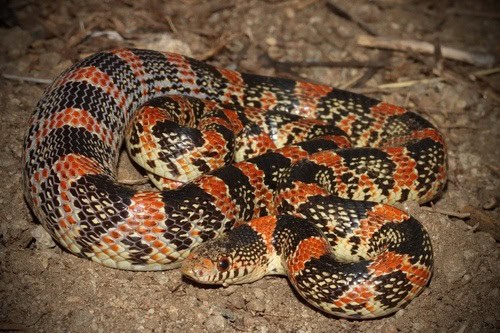
The long-nosed snake (Rhinocheilus lecontei) is a harmless species found in the southern USA and northern Mexico, which has no venom at all, not even a weak venom produced from its rear fangs. This is a medium length species, with an all-time record of 104.1cm, and only moderate constriction powers. It’s vaguely confusable with coral snakes, but has complex, bright patterns which resemble no other US species, with a mixture of white, black and vivid red.
Long-nosed snakes are found in open semi-desert areas, and are mostly nocturnal in nature. By far their most interesting feature is their snout, which is elongated and has an upward turn at the tip. This is formed from an enlarged rostral scale, and the purpose is to rummage through soft sands, and search for buried lizards. These form a large portion of their diet alongside lizard eggs.
Unlike the pine snake, this species doesn’t forge its own burrows, preferring to invade vacant mammal burrows or dark rock chambers. Instead, its snout is a long probing device, used to discover meals lurking just below the shallow upper layer of sand.
| 2 | Abundant in the US southwest |
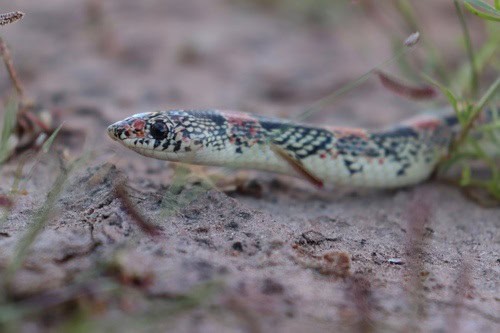
Long-nosed snakes are widespread in the southwestern USA, although they can be difficult to find due to their shy, nocturnal nature. Their main heartlands are southern California, Arizona, New Mexico, and western Texas. In eastern Texas, they completely disappear, with no presence near Fort Worth or Dallas.
Other locations include southwest Kansas, southeast Colorado, much of Nevada, western Utah, and western Oklahoma. They appear in various Mexican states, including Baja California, Coahuila, Sonora, Nuevo Leon, Durango and Chihuahua.
Long-nosed snakes are also interesting for having a distant outpost located in Idaho. This is separated from the main territory by several hundred miles. The first long-nosed snake here was reported in 1941, and only in 1972 was the second individual discovered, in Owyhee County. The colony lies in southwest Idaho along the scenic Snake River.
This species belongs to the tiny Rhinocheilus genus, which has three members. The other two are the Mexican long-nosed snake (Rhinocheilus antonii), found only in western Mexico, and Rhinocheilus etheridgei, found only on a single island in Baja California (Isla Cerralvo).
| 3 | Habitat: desert grasslands and sandy soils |
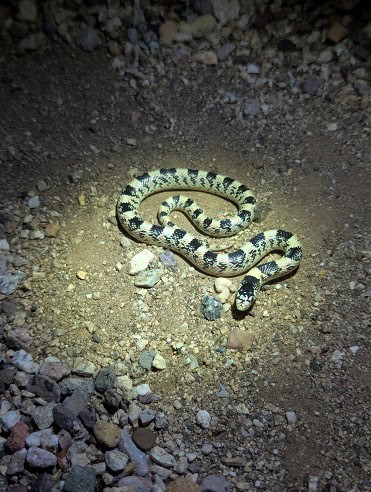
Long-nosed snakes appear in a variety of habitats, but there’s a few qualities that unite them. Firstly, they avoid high mountainous areas, with an absolute maximum altitude of 1900 metres (New Mexico).
Long-nosed snakes prefer semi-desert flats, desert grasslands, bajadas and plains grasslands, and within these habitats, they always prefer areas with wispy grasses or thick brush. They can be found slithering over open roads as well (drivers often meet them), but prefer some grassy or shrubby vegetation to weave through. They can also appear on the bushy, overgrown margins of dry agricultural fields. Long-nosed snakes cope decently with human alteration of habitats, making them resistant to extinction.
Sandy soils are a must, to allow their burrowing lifestyle. Long-nosed snakes are often spotted with grains of sand still stuck to their upturned snouts. One place where they’re almost never found is forested environments.
Although they correlate with rock cover in semi-deserts, rocks aren’t a strict requirement. Long-nosed snakes also avoid steep rocky slopes, unlike the black-tailed rattlesnake for example.
| 4 | Juveniles are more aggressive |
Long-nosed snakes lack venom and are unable to kill. But you might regret picking one up, if you get overeager in your excitement at seeing such a colourful serpent.
Their first defensive technique is biting, which is relatively rare, but actually more common in juveniles, which are feistier. Another trick is producing a disgusting snake smell, or deliberately producing blood, mixed with a foul-smelling fluid. A few have hung limply from captors’ hands as though mimicking a bloody carcass.
Thrashing from side to side is another technique, to fluster the predator/human into dropping them. Then there’s coiling into a ball to protect its own head, while simultaneously raising the tail. It’s theorised that the colourful tail is attempting to mimic a venomous coral snake about to strike.
Though adults are less aggressive, they still make mock strikes. These may connect, but they always keep their mouths closed. It’s unknown why juveniles become less willing to bite as they age. Another tendency is coiling into an S-shape, mimicking a viper’s strike posture.
| 5 | Diet: mainly lightweight lizards (racerunners) |
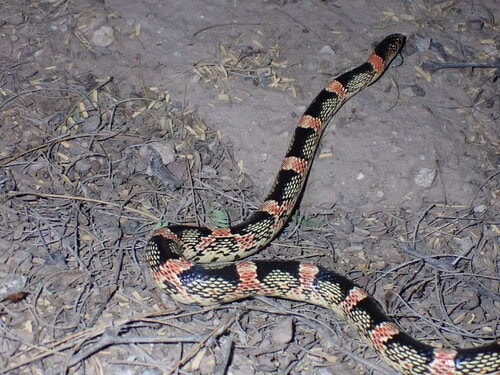
In 1999, scientists analysed the long-nosed snake’s diet in massive detail, gathering over 800 stored long-nosed snakes from museums all across the country. The study was large in scope, giving this snake a well-understood diet compared to other obscure desert crawlers.
Among over 800 individuals, 135 prey items were found overall. Most of these were single items, but 7 long-nosed snakes had two prey items in their stomachs. All meals were ingested headfirst, rather than tail-first, when the direction of ingestion could actually be determined.
Of the 126 meals, 65.9% were reptiles, 25.9% were mammals, and 6.7% were reptile eggs. There was also a lone grasshopper. This mostly agreed with the snake handbooks and guides from decades gone by; the old theories had been reproven rather than ripped apart.
Within the reptile group, long-nosed snakes tended to avoid bulkier meals such as geckos. They particularly favoured one group: the racerunners (Cnemidophorus), which comprised 72% of total lizard meals (64/89).
| 6 | Never eats snakes |
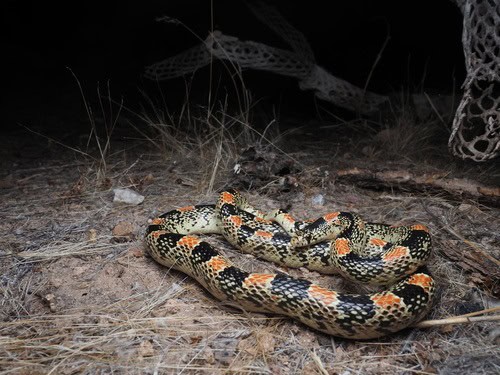
Confirmed species included the western earless lizard, six-lined racerunner and common side-blotched lizard. Confirmed mammal meals included the hispid pocket mouse and Ord’s kangaroo rat. Not all meals could be identified to the species level, as some were simply half-digested scales or scraps of fur.
The single most popular meal was the western whiptail, AKA Aspidoscelis tigris. The largest relative meal recorded in the study was a western fence lizard weighing 3.5 grams, against the long-nosed snake’s body weight of 5.6 grams, making for a relative mass of 63%.
There was also another interesting finding: not a single snake meal, despite the species’ reptilian tastes. Long-nosed snakes from Mexico tended to be larger, and therefore ate longer meals. Whether long-nosed snakes ate mammals was partially determined by size, as none with a length of below 38cm (excluding the tail) ate mammals. However, they continued to feed heavily on lizards and lizard eggs their entire lives.
| 7 | The local snake community |
In its gently sloping desert grasslands, stretching as far as the eye can see, the long-nosed snake often has two neighbours: the gopher snake and glossy snake (Arizona elegans). The former is an ultra-common constrictor, which appears in every western US state. The latter is a non-venomous constrictor, which is common in the US southwest.
The habitats of these two snakes are nearly identical to the long-nosed snake, and hence, they often coexist in a cosy, non-venomous snake community. Find one, and your chances of finding the others multiplies.
Scientists have discovered how this coexistence is possible, as a study on glossy snakes found a more mammal-rich diet (44% versus 26% of meals). The glossy snakes ate plenty of reptiles as well (50%), but focussed on bulkier lizards rather than the slender racerunners of the long-nosed snake. Meanwhile, the gopher snake mostly ignores reptiles, and eats over 75% mammals. It also has a tendency to raid underground burrows and swallow up many small mammals at once.
There’s also a 4th, more menacing member of this community: the western diamondback rattlesnake. Some species like the rock rattlesnake and black-tailed rattlesnake favour rocky slopes where long-nosed snakes will never appear. But the western diamondback slithers around flatter dry grasslands, and areas rich in brush, top locations for kneeling down and admiring a mesmerising long-nosed snake, before a piercing rattle suddenly sounds to your left just 2 feet away.
| 8 | No real lookalikes |
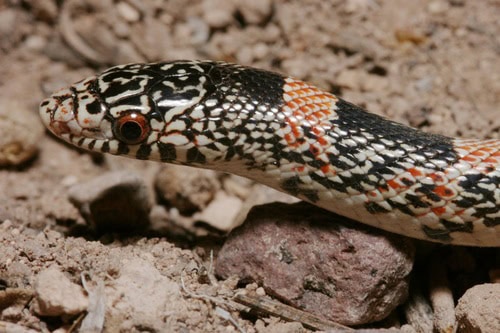
Long-nosed snakes are easy to recognise, even excluding their signature pointed snout. Their colours vaguely resemble the California kingsnake found in Arizona, Nevada and California, as both have a banded pattern. But that species is more sharply black and white (or brown and white), with no red patches. Long-nosed snakes tend to be messier and more spectacular. Although they overlap with the venomous Sonoran coral snake (Micruroides euryxanthus) in southern Arizona, that species is again far cleaner in appearance, with neatly divided white, red and black sections (red bands touching white).
Other ID signs of Rhinocheilus lecontei include reddish/orange eyes and a black tongue. Their body is medium in thickness, as they use rudimentary constriction, but not regularly; they just as frequently pin their prize to the ground or burrow wall to hold them in place.
The only confusing factor is that long-nosed snakes undergo an ontogenetic colour change. Young individuals maintain the red patches, but these are significantly paler, resulting in a more black and white appearance, similarly to a California kingsnake. Additionally, juveniles have reduced dark flecks on each scale, producing a cleaner appearance. Essentially, the adult patterns become more elaborate and detailed.
| 9 | The fake subspecies (abolished) |
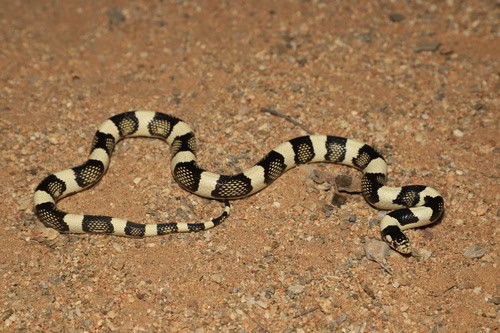
Originally, the long-nosed snake was considered to have two subspecies: Rhinocheilus lecontei clarus and Rhinocheilus lecontei lecontei. The two were divided by appearance, with a high degree of variation. L .r. lecontei had a high number of bands/markings which were each relatively narrow, and a clean underside with few markings. Meanwhile, R. lecontei clarus had fewer speckles, but broader bands and dark patterns on the underside.
The difference was sharp, hinting that a gradual genetic divergence had taken place, perhaps due to the uplift of one mountain range or another. But the theory was disproved instantly, when a single clutch of eggs from the same mother had both morphs.
In one second, the subspecies theory had become null and void. In reality, this desert snake just has several superficial morphs, without genetic variation, similarly to the Malabar pitviper of India or eyelash viper of Central America.
| 10 | The Oregon mystery |
Idaho is already a stealthy outpost of the long-nosed snake, with decades separating the 1st and 2nd sightings. But Oregon was even more mysterious, as until 2018 it was doubted that the snake even existed there. Viable habitat lay directly over the border from Idaho, in sandy canyonlands near the Owyhee River, yet the snakes remained elusive.
In 2018, respected herpetologist Al St. John issued a request for sightings in the area. He had been prowling southeastern Oregon for 50 years with no success. With the power of the internet, he issued an appeal, but probably didn’t expect to be rewarded the next day.
John received photos and information from two more herpetologists, Alison Davis Rabosky and her husband Dan, who had stumbled across a long-nosed snake on Owyhee Lake Road in 2010. Better, they hadn’t even realised it was a significant discovery. They had made the first state record without realising it.
St John updated his article to include the discovery, and southeast Oregon became an official long-nosed snake outpost. It took until 2026 for more sightings in the state to emerge. 5 more photosets were uploaded to inaturalist.org by random civilians, confirming the mysterious colony’s continued existence. As of now, just 6 observations of this species in Oregon are on record.
| 11 | Predators of the long-nosed snake |
Scorpions – if a long-nosed snake mistimes the moment it pokes its head up from its dark mammal burrow, it could be seized in the pincers of a giant hairy desert scorpion (Hadrurus arizonensis), as observed in La Paz County, Arizona in September 2009. A scientist videotaped a scorpion moving across a dry habitat carrying a helpless long-nosed snake in its pedipalps. The long-nosed snake wasn’t mangled like roadkill, and nor did it have rigor mortis. Therefore, it was probably a genuine catch and not a case of scavenging.
California kingsnake – the most frequent snake-eating (ophiophagous) snake in the southwestern US. California kingsnakes prey heavily on gopher snakes, and more notoriously rattlesnakes, particularly the Pacific rattlesnake, with full venom immunity. But the long-nosed snake was confirmed as prey in a 2019 study, which analysed 2662 California kingsnakes from museum collections. The species regularly share habitats, as California kingsnakes also favour open areas like grasslands.
Ground squirrels – in Kent County, Texas, in May 2012, a scientist spotted a Rio Grande ground squirrel running along a dirt road with an object in its mouth. The squirrel dropped the item and began feeding for 1-2 minutes. The researcher then clapped his hands, spooking the squirrel and causing it to flee. Its meal turned out to be a long-nosed snake, which was covered with incisor marks.
Itself – long-nosed snakes violate one of the scared laws of nature and commit cannibalism, as observed in May 2009 in Alameda County, California. The aggressor long-nosed snake was an adult measuring 90cm, and the meal a juvenile measuring 32cm. The observation took place at 23:07.
More – other confirmed snake predators of the long-nosed snake include the Sonoran coral snake (Micruroides euryxanthus) and coachwhip.
| 12 | Wrestling rituals |
Long-nosed snakes have no power to harm humanity, unlike the western diamondback rattlesnake. Nor do they have any intention of helping humanity, unlike the gopher snake, which unwittingly offers a helping hand by eating rodent pests in farmland. Instead, the long-nosed snake lives completely separate from the human race. It lives in a different world entirely, in parched desert grasslands stretching far over the horizon, a cryptic world of serpent rules and laws which we cannot possibly understand.
One of these bizarre alien rituals may be wrestling, as observed in Sinaloa state, Mexico. Male wrestling has been recorded in dozens of snakes worldwide, and several within the USA.
The long-nosed snake joined the club in July 1980, when researchers came across two individuals, intertwined from head to tail, with their bodies coiled sinuously around each other. The snakes were wrestling so furiously that they were moving across a cultivated field at high speeds. When they noticed the scientists, they didn’t halt their slithery spaghetti war, but simply changed direction.
Eventually, the scientists separated the snakes and proved them to be two males rather than a male and female. The one caveat is that the species observed was the Mexican long-nosed snake (Rhinocheilus antonii), but given their close relation, it’s likely that the US long-nosed snake has similar tendencies.