
| 1 | Found in spacious Florida woodlands |
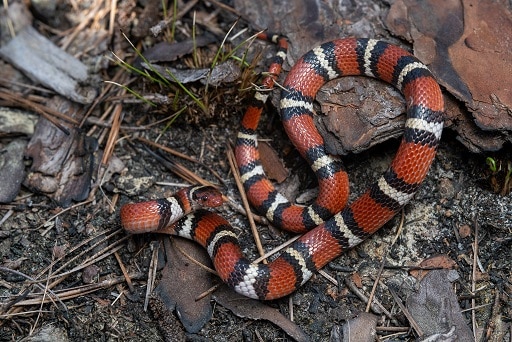
The scarlet kingsnake (Lampropeltis elapsoides) is a harmless species which lives in forests of the southeastern USA. Its stronghold is Florida, where it’s found in every county except the Keys, but it also inhabits Georgia, South Carolina, Alabama and more. This species is moderately common, inhabiting 10 states overall, reaching as far north as central Virginia.
Scarlet kingsnakes are completely non-venomous, and mainly live in sparse to moderate forests. They lead a semi-burrowing lifestyle, spending much of their time below the soft forest floor, enlarging tunnels made by small mammals. In southern Florida, one of their favourite trees to lurk near is the introduced Australian pine.
Though they spend their lives among trees, scarlet kingsnakes rarely cling to branches, preferring to hide on the cluttered floor amid old branches and loose twigs. It’s rare for this species to enter towns, but they’ve been found in scenic swimming pools near forests every so often.
Scarlet kingsnakes have an average length of 50cm, and an all-time record of 68.6cm, which is almost the shortest of the Lampropeltis kingsnake clan they belong to. Another member in Florida is the common kingsnake, but this is black and creamy white instead, without a single patch of red. It’s also significantly longer, with a record size of 208.3cm, making the two impossible to confuse.
| 2 | Wedges itself between tree bark |
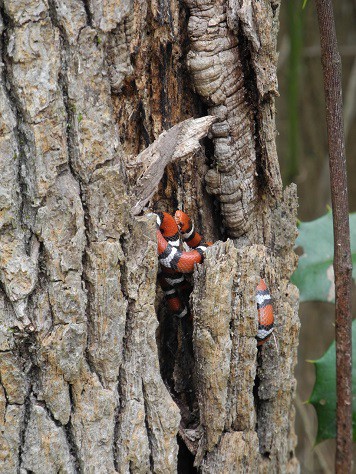
Scarlet kingsnakes have very memorable colours, with red, white and black bands, with the white sometimes being yellow. Theoretically, this should stand out effortlessly against a forest floor, yet this species is surprisingly hard to find.
This isn’t a snake which people bump into while crossing the road, as even dedicated herpers can spend months trying to track a scarlet kingsnake down, only to walk away empty-handed. They’re also highly nocturnal, adding even more to the difficulty in finding them.
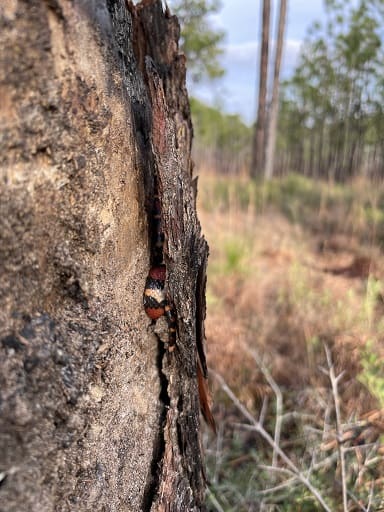
That said, there’s one secret way to find the scarlet kingsnake that’s amazingly effective. Within forests, a scarlet kingsnake’s favourite spot isn’t below fallen leaves, or piles of rocks, but in the loose bark of dead trees.
Scarlet kingsnakes are strangely common behind strips of bark, peeling away from trees, revealing the bare wood below. They particularly love rotting bark on the stumps of old pine trees, wedging themselves firmly in the tight gaps (probably while surrounded by woodlice). Both standing and fallen pine trees are fine, and anyone searching for a scarlet kingsnake should head to those trees first.
| 3 | Their deadly lookalike |
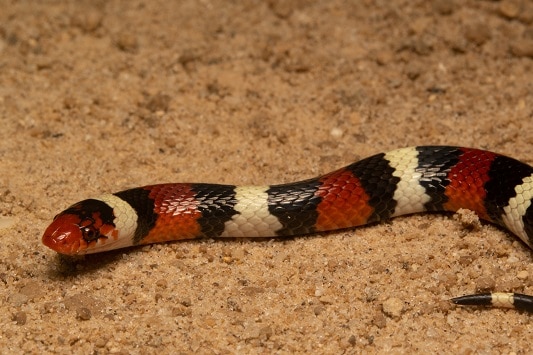
Scarlet kingsnakes are notorious for being mistaken for the eastern coral snake, one of Florida’s most lethal snakes, which is an uneasy neighbour in their forest floor domain. The resemblance is clear, as both have red, black and yellow bands and small beady eyes.
Like the similarly-coloured scarlet snake, this inspired a nursery rhyme with about 1000 incarnations. The standard is “red touches black, venom lack” followed by “red touches yellow, kill a fellow”, referencing the ordering of the pair’s bands. Within the US, the rhyme is completely accurate, as scarlet kingsnakes generally follow a sequence of red, black, yellow, black, red, black, yellow, black, continued to eternity. The eastern coral snake always has red patches touching yellow.
Catchy rhymes aside though, a really obvious giveaway is that the scarlet kingsnake has a red face and chin. An eastern coral snake’s face is pure black, so black that the eyes are barely distinguishable.
Another secret sign is that with the eastern coral snake’s bands, they join at the belly, barely changing in appearance compared to their back. With the scarlet kingsnake, the bands almost touch, but there’s always a thin white line separating them. Their bellies also have checkered markings sometimes.
| 4 | Harmless, but misidentified |
Eastern coral snakes are also longer than their neighbour, averaging at 80cm with a record of 129.5cm (in 1996). Scarlet kingsnakes average at 50cm and the maximum on record measured just 68.6cm. With scarlet kingsnakes, the red patches are easily the largest, while eastern coral snakes have equally large red and black patches (only the yellow bands are thin).
The older the scarlet kingsnake, the trickier distinguishing the two becomes. As juveniles, the yellow patches are pure white, but the longer they survive, weaving past bird predators and growing centimetres each year, the more pigment accumulates in these stripes and the yellower they become. The yellowing begins at 3 months, and continues imperceptibly.
There’s also geographical variation, as some spots have whiter bands, while other unpredictable locations have more yellow-banded individuals. The shade varies significantly, from lemon yellow to the intensity of an apricot. Each stripe itself can have varying colours, as some are pale near the belly and darken closer to the spine. Meanwhile, a scarlet kingsnake’s red and black bands are constant throughout its entire life – it’s only the pale band which varies.
| 5 | Diet: specialises in lizards |
The scarlet kingsnake isn’t a species that slithers around and mindlessly swallows everything up without even blinking. Few animals meet its strict requirements. Instead, scarlet kingsnakes get most of their meals from skinks.
As a percentage of its diet, the scarlet kingsnake is the top skink-eater of any North American snake. It’s wildly different to its close milk snake (Lampropeltis triangulum) relative, which is a heavy mammal-muncher. This is one reason why scarlet kingsnakes were separated into their own species. To help them in their quest, scarlet kingsnakes have enlarged anterior teeth, like other skink specialists around the world.
The best study so far investigated old, stored museum specimens of scarlet kingsnakes. The main conclusion was that the species’ diet was far narrower than previously thought. Of 42 food items found, 74% were skinks, while 15% were snakes.
A single mouse was found as well, as was a set of skink eggs. Two skink species were clearly dominant above the rest: the ground skink and southeastern five-lined skink.
| 6 | Occasionally feeds on snakes |
Another discovery was that 97% of the scarlet kingsnake’s meals were elongated, rather than bulky and round. This is because scarlet kingsnakes have a small gape size; they cannot open their mouths very far, compared to the average snake.
Scarlet kingsnakes prey heavily on fellow snakes as well. They’re limited by a small size, but the study above found the following meals: two ring-necked snakes, a rough earth snake, a garter snake (species undetermined) and a southeastern crowned snake.
One tale happened in Forrest County, Mississippi in 2005. A researcher found a scarlet kingsnake lodged in the bark of a fallen longleaf pine, which spooked the snake, and forced it to regurgitate two small ring-necked snakes. This species also likes forests, and is similarly fond of old rotting bark, so it’s not surprising that the two come face to face. The ring-necked snakes measured 15-20cm, while the scarlet kingsnake measured 40cm.
24 hours later, the researcher returned to the scene of the crime. The plot thickened, as the scarlet kingsnake was still lodged in the bark, but the ringneck snakes were nowhere to be seen. The scarlet kingsnake also had an odd bulge in its stomach. No-one was able to answer this riddle.
| 7 | Copycat or pure coincidence? |
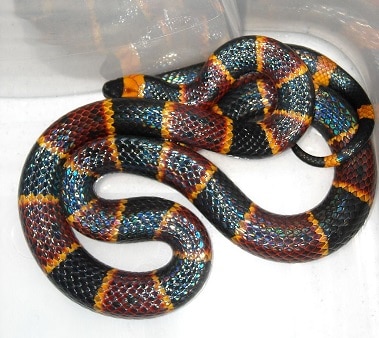
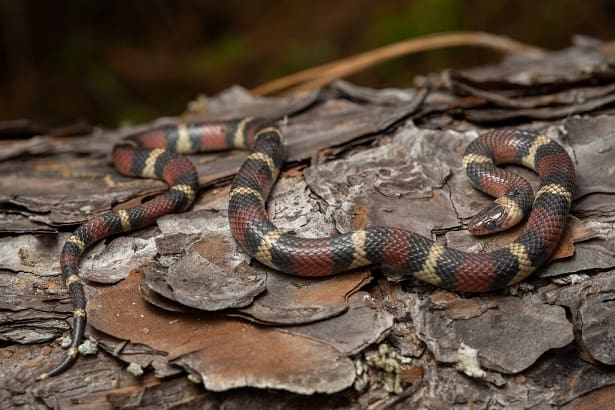
The obvious theory about the similar colours is that eastern coral snakes (pictured above) are venomous, and that scarlet kingsnakes have evolved to mimic them. This would protect them against birds without lifting a finger, with the hard gruelling work done during evolution, allowing them to reap the rewards forever.
But another theory is that scarlet kingsnakes evolved to mimic a shadowy forest floor. This species moves at night, and in darkness, the bands perfectly mimic moonlit areas alternating with dark patches. The eastern coral snake also lives in forests, and might have evolved its patterns for the same reason. Essentially, the two colour schemes may have developed independently of each other because of the same habitat pressure, rather than copying each other.
A sign that the colours are a mimic is that scarlet kingsnakes only rarely have broken tails. This is a classic sign of predator attack in adult snakes, which most can survive for years, but scarlet kingsnakes mostly avoid this fate (the eastern ribbon snake is one of the top species for broken tails). Likewise, it’s rare for eastern coral snakes to have broken tails as adults.
| 8 | Strangely similar pigments |
Another possibility is a combination – that the scarlet kingsnake’s colours evolved because of the forest floor originally, then accelerated as it gained protection from predators by accident.
One study examined a spot in North Carolina where eastern coral snakes mysteriously went extinct in 1960. Not only did the scarlet kingsnakes keep their protection, it actually strengthened. The local predators still had the instinct to avoid red, black and yellow bands.
Scarlet kingsnakes even possess the exact same pigments making up the red, yellow and black colours. Yellow can be produced by many pigments in nature, such as sepiapterin or xanthopterin. Human skin, for example, has yellowness determined by carotenoids, which is why too many carrots can turn you orange.
However, both scarlet kingsnakes and eastern coral snakes use pteridines for their yellow bands. For black, they both used eumelanin sequestered within melanosomes, and for red, they both used drosopterin. The two snakes also possessed an extensive layer of guanine crystals below the yellow bands, which amplified the colour. These crystals only had minor differences in structure, although they penetrated deeper in the eastern coral snake.
| 9 | An exact mimic isn’t required |
It turns out that scarlet kingsnakes barely have to be precise at all to benefit from their mimicry. The colours themselves are a decent enough shield, even if the ordering is as precise as a drunken artist swabbing wildly with a paintbrush.
A study from North Carolina tested scarlet kingsnakes with varying similarities to eastern coral snakes. Whether the order of the rings matched the coral snakes made little difference to their protection from predators. Perfect mimics were no less likely to be attacked than merely good mimics. However, the proportion of red and black was very important – the closer the match, the higher the protection.
Overall, the scarlet kingsnakes only had to broadly match their venomous neighbours, they didn’t have to be a mirror image. This makes sense given that birds only have a split second to make a decision. All it takes is a quick flash of bright colours for their brains to pick up “toxic” and reverse course.
Like a human who starts screaming and runs straight into a swamp like a headless chicken, a bird cannot instantly distinguish between two snake species using its eyes alone (the eye of the eagle has its limits). It’s believed that scarlet kingsnakes evolved to exploit this weakness.
| 10 | Connection to the milk snake |
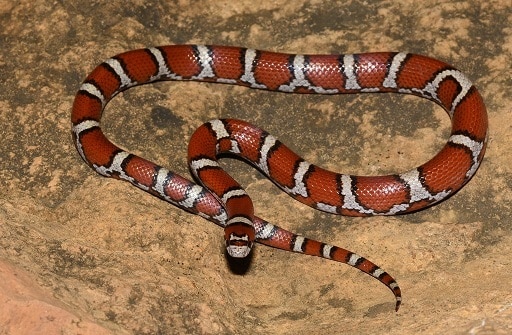
Scarlet kingsnakes belong to the huge snake genus of Lampropeltis. This includes at least 26 species across the Americas, including the milk snake (Lampropeltis triangulum), which itself has 25 different subspecies, the most common being the eastern milk snake.
For decades, scarlet kingsnakes were considered to be the 26th milk snake subspecies. Milk snakes also possess beady eyes and black, white and red banding, with the same order. But several clues contradicted this thinking, as the scarlet kingsnake was easily the smallest “subspecies”, at 40cm versus 60-100cm. Its diet was by far the most skink-heavy, and the eastern milk snake’s face is smattered with white rather than fully red. The red bands are duller, and the bands also have different proportions.
Consequently, the scarlet kingsnake was split off in 2009 and became its own full species: Lampropeltis elapsoides. The furthest north scarlet kingsnakes extend to is southern Virginia, while their western flanks reach southeastern Louisiana. Milk snakes generally live further to the northwest.
| 11 | Lays eggs in rotting bark as well |
Scarlet kingsnakes always grab their lizard prey headfirst, at least when they succeed in swallowing them. One study examined their lizard prey such as common five-lined skinks. It found that in 100% of the cases when scarlet kingsnakes grabbed them tail-first, that tail snapped off and the lizard dashed to freedom, ready to regrow the tail slowly.
Scarlet kingsnakes lay eggs, with numbers varying from 4-12. The rotting bark they hide in is a perfect place to stash their unborn children, and they also bury them several inches deep in soil.
The eggs are white, elongated, and stick together slightly. Scarlet kingsnakes are also longer-lived than average, despite their small size. The record in captivity was 22 years and 4 months.
Another handy mimic tip is that the empire of scarlet kingsnakes reaches much further north than eastern coral snakes, even into Kentucky and Tennessee. Another confusing similarity is that both species have smooth, glossy scales, which you can stroke without pain (except when they get annoyed and bite you).