
| 1 | Ranges from Canada to northern Mexico |
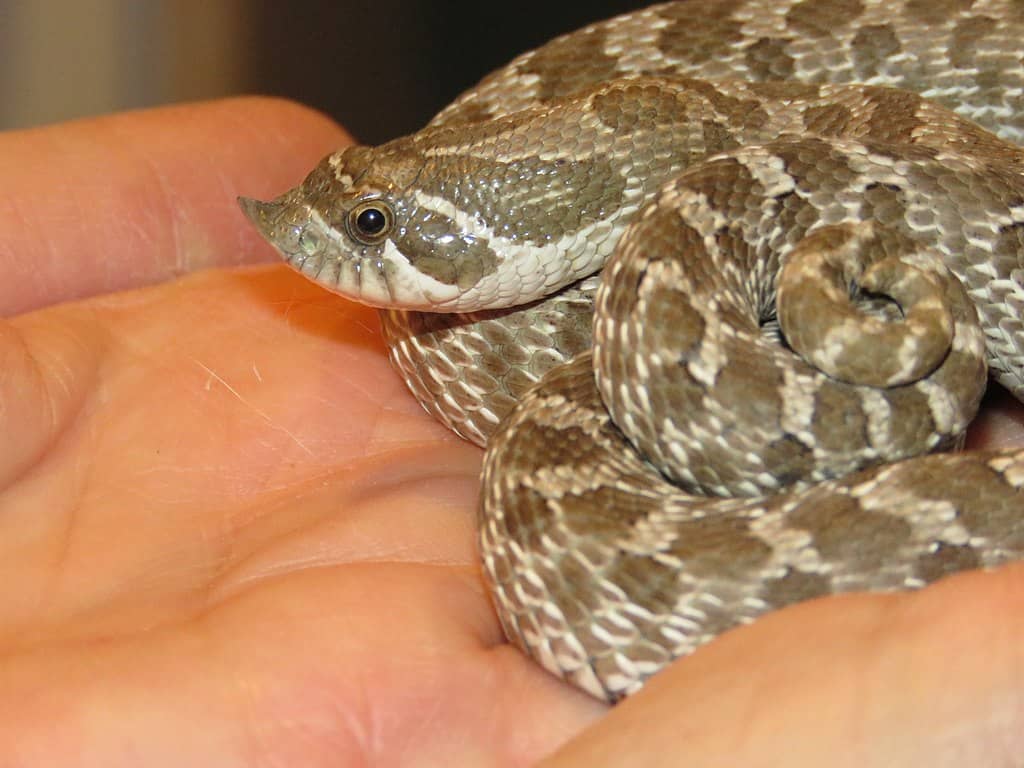
The USA is home to 4 official hognose snake species (Heterodon genus). The southern hognose snake is the rarest, with less than 10,000 thought to remain, while the Mexican hognose snake is an extreme southern species, only spilling over the Mexican border in parts of Texas, New Mexico and Arizona.
The eastern hognose snake is the most common, appearing in most states east of the Mississippi River, and many to the west, covering 35 states overall. The final species, meanwhile, is the western hognose snake (Heterodon nasicus), which covers a healthy 15 states overall, as well as a decent portion of Canada over the northern border.
The western hognose snake is a moderately long species, with a maximum ever length of 100.6cm. As the name suggests, this is the most westerly of the 4 species. Rather than the west coast, it inhabits a swathe of the Midwest, appearing mostly to the west of the Mississippi River, but to the east of the Rocky Mountains.
You can find this species in northern Texas, eastern Colorado, eastern Wyoming, Kansas, Nebraska, eastern New Mexico, Montana and parts of South Dakota. States where it doesn’t appear include Wyoming, Nevada and Utah. There’s also an isolated colony of this snake further east in Minnesota, not far from Minneapolis.
In Texas, western hognose snakes are very common near Lubbock. In Colorado, they’re abundant near Denver, before suddenly disappearing as the Rocky Mountains begin their steep ascent. Wherever western hognose snakes live, they can be difficult to find, for two reasons: 1) their great camouflage, and 2) their strong burrowing tendencies.
| 2 | A sand-loving snake |
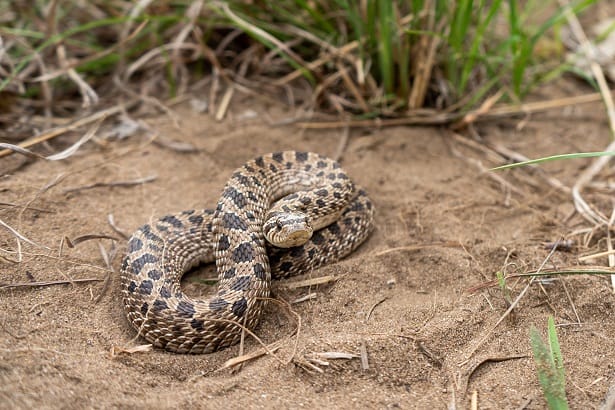
Rather than forests, the western hognose snake is primarily found in open habitats, including sweeping prairies, scenic grassland, scrubland, and semi-open deserts. This snake is rare in forests, and its favourite habitats of all are those with plenty of sand.
Western hognose snakes are naturally drawn to inland sandy environments, whether it be riverbanks, sand dunes, or sandy flood plains. Their favourite habitat of all is the sand blowout: areas exposed to high winds where virtually all vegetation has been stripped away. These blowouts are such hognose snake hotspots that scientists researching them automatically head there first.
One reason for this sand obsession is that these locations are easy to burrow in. Western hognose snakes spend 71% of their time underground, according to one study, usually by creating their own personal tunnels. Combined with their sandy beige scales, this makes them very difficult to spot at times.
Western hognose snakes can be severely lazy, moving mere metres per day in their windy sand blowouts. But they can randomly turn adventurous as well, particularly when seeking out mates. One female snake was marked in September 2010, and had moved just 49 metres when it was finally recaptured in June 2011. Yet another female moved 300 metres in 24 hours.
| 3 | The famous hog nose |
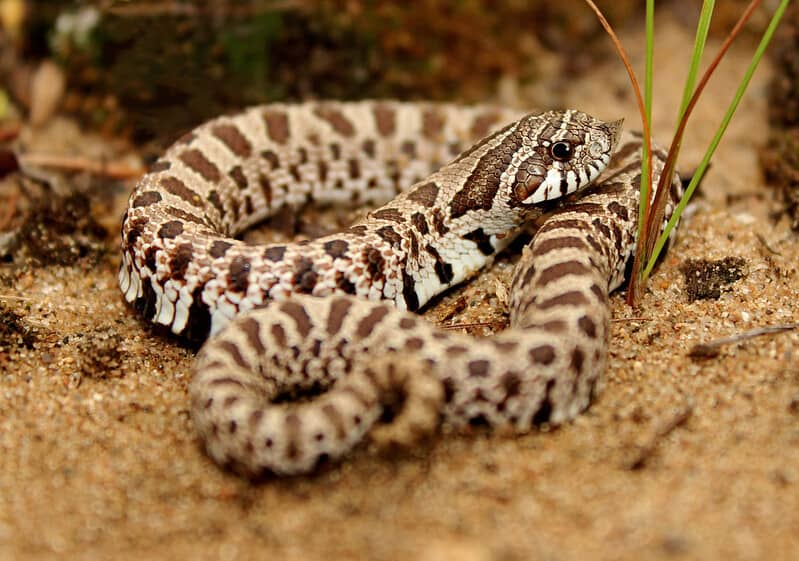
The western hognose snake is medium-sized for an American snake, with an average length of 50cm, and 100.6cm as the upper limit. Its body is a moderate width, neither thin like a twig nor bulky like a log.
With its subtly varying black-brown shades, some believe that this species evolved to mimic a rattlesnake. If so, the plan is working, as western hognose snakes regularly scare explorers into running for the hills.
This snake has beady black eyes with round pupils, and one telltale sign is a significantly darker head than the body. However, the iconic feature is clearly the namesake hognose. The Latin name of Heterodon nasicus references this nose, which is sharply unturned in order to dig in sand.
In fact, the western version has a significantly more upturned nose than the eastern hognose snake, which still has a probing nose, but more horizontally. The 4 hognose snake members also have very flat faces, as though they’ve slithered into a wall too fast and been squashed.
| 4 | Enormous back teeth |
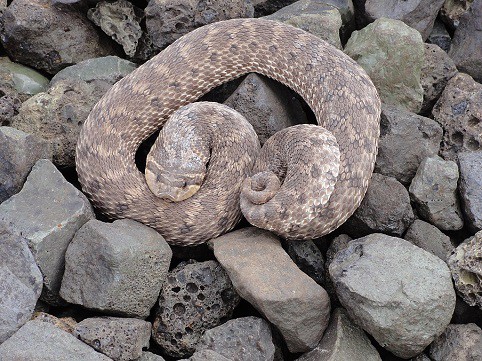
The western hognose snake is neither a crushing constrictor nor a venomous assassin. Instead, this species acquires its meals the hard way, prowling endlessly around its sandy landscapes and watching keenly for the flash of a lizard tail disappearing
Western hognose snakes have ultra fast reflexes, and can pounce on fleeing prey in a flash. They then apply a full body coil, not to constrict the struggling lizard, but to hold it in place.
A special feature of American hognose snakes is their massively enlarged rear teeth. These are widely believed to be for puncturing toads, when they inflate like a balloon to prevent snakes from swallowing them. However, they’re actually used to grip these slippery amphibians, to hold them securely in their mouths.
Yet another adaption is resistance to toad toxins. The bufotoxin manufactured by American toads (Anaxyrus americanus) can slow the heartbeat to fatal levels, both in humans and regular snakes. Western hognose snakes have evolved enlarged adrenal glands, which release extra adrenaline and norepinephrine, to keep the blood pumping, counteracting the toad’s ultimate defence.
| 5 | A death-faking snake |
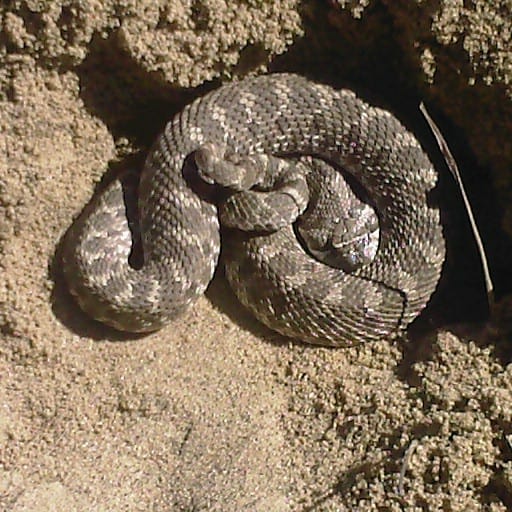
Heterodon nasicus is sometimes dubbed the spreadin’ adder by American locals, because of a defensive tactic where it widens its ribs to create a false impression of size. This species also hisses loudly when threatened, and bashes people harmlessly with its mouth tightly closed.
However, hognose snakes are most famous for their legendary play dead antics. The earliest US settlers were amazed by their tendency to writhe on the ground as though in mortal agony. A frightened hognose snake will loll out its tongue, flip onto its back dramatically, and go completely limp, in scenes worthy of Shakespeare. Some diehard individuals even produce a disgusting-smelling liquid, which they roll around in and smear everywhere.
This death-faking routine must succeed against birds and racoons, if it stuck around and managed to spread to descendants. However, a few manage to screw it up; one western hognose snake was spotted flecking its tongue while all other performance aspects were perfect. The instinct for flipping means that when researchers turn a hognose snake onto its stomach, it sometimes flips back instantly, kind of defeating the purpose.
| 6 | 10 million years ago |
Nobody has a complete chart showing the evolution of all snakes, but thanks to a fossil discovered in 1973, this species’ path is clearer than some. The skeleton was unearthed in Red Cloud quarry in Webster County, Nebraska, and was unusually complete for a fossilised snake.
The skull’s shape differed slightly to modern hognose snakes, but was easily recognisable. Most importantly, the signature massive rear teeth were already in place, hinting that they already ate slippery amphibians. The species was dubbed Paleoheterodon, compared to Heterodon for modern hognose snakes.
Over 100 fossilised animals were unearthed in the same layer, allowing researchers to pinpoint the fossil’s age at 13 million years old. Other fossils included horses, camels and grazing animals complete with preserved grass seeds. This indicated that the ancestor hognose snake inhabited the same sweeping short grass prairies as now. Some of the preserved animals such as boas, camels, giant tortoises and coral snakes are gone from the Great Plains today, but the hognose snake is a survivor.
| 7 | Diet: plenty of turtle eggs |
For decades, it was assumed that toads and frogs were the western hognose snake’s dietary staple. However, a 2016 study from the Thomson Sand Prairie in Illinois found a diet consisting of 51% turtle eggs.
Toads, including the American toad, were the second largest portion at 23%. Lizards were also plentiful, including the six-lined racerunner, but mammals were nowhere. A common frog prey was the northern leopard frog.
Being so familiar with burrows, western hognose snakes can effortlessly invade a mother turtle’s egg chamber. A 2011 study returned to Illinois and this time observed 7 hognose snakes hunting voles, specifically the prairie vole. However, turtle eggs still dominated, the favourite being eggs of the common snapping turtle (Chelydra serpentina).
In nature, the yellow mud turtle is a rare turtle species to care for its eggs after being laid. Western hognose snakes from Nebraska have been seen raiding these eggs, leading some to theorise that this serpent is why the parental care first evolved.
| 8 | Mild, finger-swelling venom |
If you wake up on a sand dune hungover, and look up to see a western hognose snake peering at you, there’s little to fear. No deaths have been confirmed for this squashed-looking snake.
However, while western hognose snakes lack traditional front fang venom, they do produce a mild venom through their rear fangs. After tearing open a bite wound using their brutally large teeth, they must chew repeatedly to force the venom in (like the ring-necked snake).
An index finger bite in 1985 saw the victim ooze blood and fluid, and develop painful blisters lasting almost 2 days. When Dr Bragg was bitten on the thumb in 1960, he experienced swelling covering 1/3 of his arm. The worst case was in 2002, when a man was bitten on the ankle. The entire foot was soon swollen, and haemorrhaging blood, which extended 10cm up his leg. The tissue only fully healed after 3 months.
Western hognose snakes have a nastier venom than once believed, but they’re also docile. Bites are very unlikely unless you pick one up.
| 9 | The worst recorded bite |
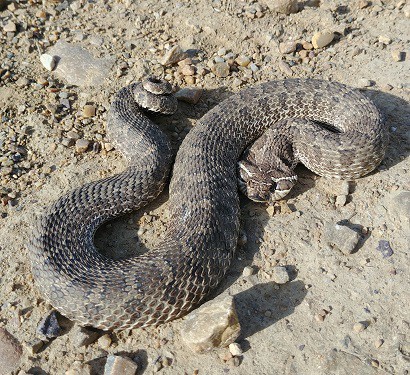
One western hognose snake incident happened on July 9th 2006. A scientist owned a 60cm male snake, which he had scooped up from the wild in 1990, and fed mice to great success ever since.
The scientist opened the snake’s cage, to change its water bowl, when it rushed out eagerly, as though expecting a fresh mouse. The scientist gently lifted his pet, but the snake bit down, sinking its fangs into his left little index finger, penetrating to the bone.
The scientists remained calm and placed his hand on a coffee table, hoping that the snake would release naturally. It didn’t. Next, he attempted to prise its mouth open with a pencil. This caused the snake to chew harder, causing the scientist ever-sharper pain. He then placed the finger and still-attached snake under a running tap for 1 minute.
Finally, he managed to detach the stubborn hognose snake using two pencils. The whole incident had taken 10 minutes. The wound was still bleeding, and so the scientist washed it with antibacterial soap. A mild stinging was beginning, and his finger was now swollen to the knuckle, preventing him from bending it.
By July 10th, the swelling had spread to his hand, extending 7cm beyond the finger. The zone had a purplish tinge, and he was no longer able to form a fist. The hognose snake was still in its cage – watching, listening, who knows.
By July 11th, his little finger had deflated slightly, but his ring finger was so swollen that he couldn’t wear his wedding ring. It took until July 13th, 4 days post bite, for the symptoms to fully heal.
| 10 | Eaten by other snakes |
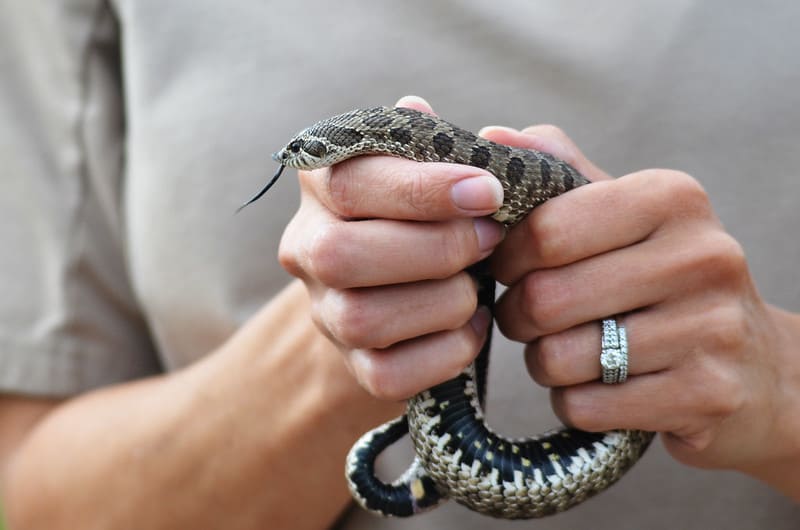
Western hognose snakes have contact with other snakes, but not by sending noble emissaries with messages. Rather, they often get eaten by them. They’re confirmed in the diet of kingsnakes, which are ubiquitous across the US and eat various snake species.
On June 5th 2017, a coachwhip was spotted on a dirt road in Bitter Lake, New Mexico, slithering towards a dead western hognose snake. The coachwhip commenced eating immediately, barely rearranging its prey’s corpse.
The coachwhip is an alert, notoriously fast snake, which also prefers open areas and reaches 2 metres, giving it plenty of stomach room. This was the first ever record of one eating a western hognose snake.
One study compared hunting styles, and found that corn snakes and ratsnakes swallowed their prey headfirst 83% of the time. However, the western hognose snake only scored 30%. This species is a more flexible eater. Western hognose snakes were also far quicker eaters; their average swallowing time for prey (when grabbed headfirst) was only 32.5 seconds, vs 158.1 seconds for the black ratsnake.
| 11 | Endangered in certain regions |
Western hognose snakes aren’t marked as officially endangered by the federal government. However, they’re declining in some regions more rapidly than others, as their natural habitats are slowly absorbed by mankind’s eternally spreading sprawl.
The southern US states are in good shape, as there’s an abundance of semi-sandy territories. It’s places like Illinois and Manitoba, Canada where the clouds of doom are descending. Their preferred short grass prairie habitats are vanishing, as are inland sand dunes. In Canada, one of their remaining strongholds is the Spirit Sands 118 miles west of Winnipeg. One unusual threat is being caught in plastic meshes used to prevent soil erosion.
Overall, western hognose snakes have declined, but they’re doing far better than the southern version, which now numbers less than 10,000 in the wild.
found on in Carbondale. IL May 22, 2025
found a hognose a few years ago in south central Colorado just above the Rio Grande river on the border with NM. (might have been in NM, but I live in Colo so I am claiming him).
never seen a hognose before so we got out of the 4runner to take a look at him. Knew he wasn’t a prairie rattler, but had never seen this type before. As we got within about 5 ft he kind of coiled and hissed really loud. Scared the poop out of us.
Then flipped over and played dead. As we approached he flipped back.
Cool snake. My buddy was from Neb and said the thought it was a hog snake, got home looked it up and sure enough. Really worth the trip.