
| 1 | Deschausensee’s keelback |
Maximum length: 85cm (estimated).
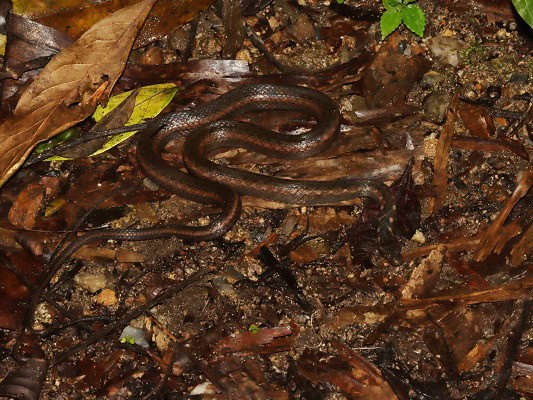
A completely harmless snake of northern Thailand, and a rare one too. Deschausensee’s keelback is found in low-lying hilly forests, usually close to streams, and never in urban areas. This is a semi-aquatic species, which is believed to feed mainly on frogs.
Deschausensee’s keelback is a mysterious species; no detailed studies have been conducted on its biology, due to its elusive nature. But one thing we can deduce from photos is an exceptional ability to camouflage, particularly in moist, rain-soaked undergrowth.
This species is also found in Vietnam and southern China, but has only a handful of sightings in each. In certain areas of northern Thailand, Deschausensee’s keelback can be very common, but it’s never an easy snake to find. It’s not only rare, but blends into its surroundings with ease. This species mainly sticks to the ground, and hence, it lacks any green on its body, sticking to alternating stripes of brown and lighter brown instead.
| 2 | Malayan pitviper |
Maximum length: 100cm.
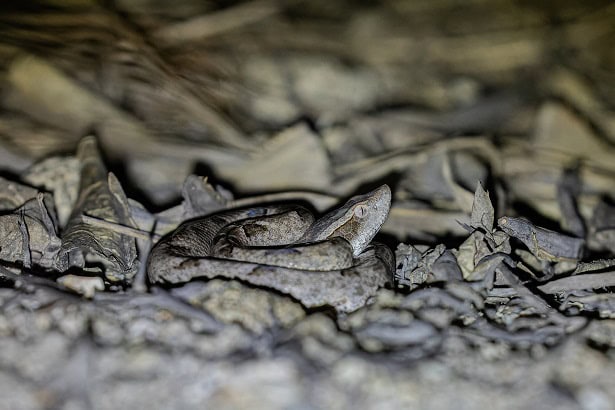
The top ranked snake in Vietnam when it comes to bites annually. This species not only has incredible camouflage, but becomes particularly dangerous because of it, surging past other venomous snakes like the ruby-eyed pitviper in local bite statistics.
Malayan pitvipers (Calloselasma rhodostoma) are found in Thailand, southern Vietnam, Cambodia and peninsular Malaysia. They generally stick to the ground, climbing branches only occasionally. Their camouflage is fine-tuned for blending with leaves, dry branches, and other fallen woodland debris. In the right spot, this species can be almost invisible.
One reason for this species’ high bite rate is a tendency to lurk in plantations, where workers are busy picking produce. Malayan pitvipers are severely dangerous, with necrosis affecting up to 95% of patients.
Spontaneous bleeding is a common symptom, including on the brain. Amputations are occasionally reported, and deaths are confirmed, though relatively rare if antivenom is administered. This species also has a caring side, as mothers are confirmed to coil around their eggs for up to 45 days after laying.
| 3 | Striped stream snake |
Maximum length: 68cm.
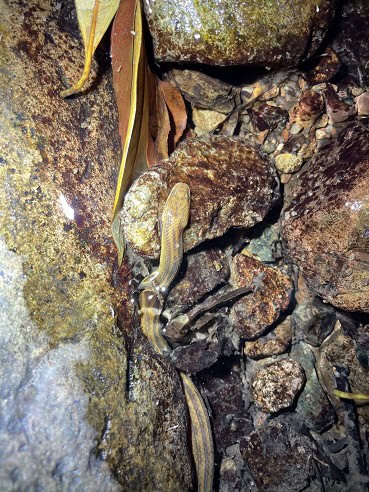
This species is the exact opposite of the Malayan pitviper, except in its exceptional camouflage abilities. The striped stream snake (Opisthotropis kuatunensis) is found across southern China, and has a particularly high number of sightings in Hong Kong. It’s a completely harmless snake, with no risk in picking one up in the palm of your hand, except for a foul smell it has a tendency to release.
Striped stream snakes nearly always appear in water bodies, such as shallow streams with a rocky base (like above). With a mixture of brown and beige stripes, they blend perfectly with these environments, causing most people to wander past them in complete obliviousness.
Other physical features of this species include an elongated snout, designed for foraging through underwater rocks. They also possess enlarged scales on their head and mouth (labial scales) to shield their face from friction against the jagged rock surfaces. Striped stream snakes aren’t particularly well researched, but are believed to prey on a mixture of frogs and fish.
| 4 | North Philippine temple pitviper |
Maximum length: 96.3cm.
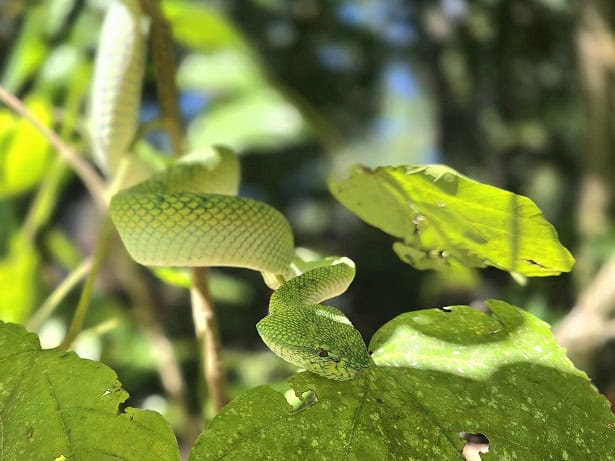
A common branch-dwelling pitviper, which disappears into leaves and other green foliage using leafy green patterns. This venomous species is widespread on Borneo, the large island split between Indonesia, Brunei and East Malaysia. It’s also found across the Philippines, and on Sulawesi in eastern Indonesia.
The North Philippine temple pitviper (Tropidolaemus subannulatus) is nearly always found on branches, reaching up to 20 metres above ground, and only occasionally venturing to the forest floor. On the ground, it sticks out like a sore thumb, but on the branches where it’s comfortable, this species can be almost invisible.
Fortunately, this is one of the milder pitvipers of southeast Asia. Bite totals are fairly high, as a study from 2015 to 2021 found 4718 snakebites overall in Malaysia, of which this species contributed 190. However, the effects were relatively mild, with little effect on blood clotting. The authors even recommended that Tropidolaemus subannulatus be removed from the World Health Organisation’s list of grade 2 venomous snakes, finding the species to be less lethal than previously believed.
| 5 | Brown kukri snake |
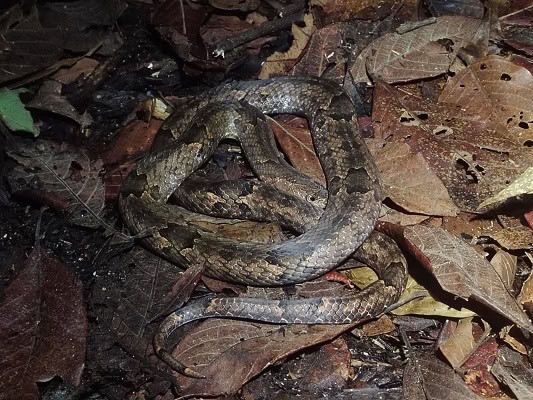
Maximum length: 95cm.
A non-venomous but potentially aggressive species, which is widespread in southeast Asia. The brown kukri snake (Oligodon purpurascens) is firmly a forest species, but sticks to the ground rather than climbing branches. Its diet consists of small geckos and skinks, and occasionally bird eggs, usually those of ground-nesting species.
This species has a few survival tricks, such as jagged fangs which can be used to slice through skin. But the brown kukri snake relies on one quality above all: its immense camouflage. This species blends into the forest floor with ease, with alternating brown and dark brown patches which seem designed to mimic fallen leaves and twigs. It then multiples this power with a natural attraction towards shelter, hiding below piles of leaves or loose bark whenever possible.
Brown kukri snakes are found in Singapore, peninsular Malaysia, southern Thailand, Borneo and Sumatra. They vary in colour, as a few have a more intense red morph. Even these are harder to spot than you’d expect.
| 6 | Borneo pitviper |
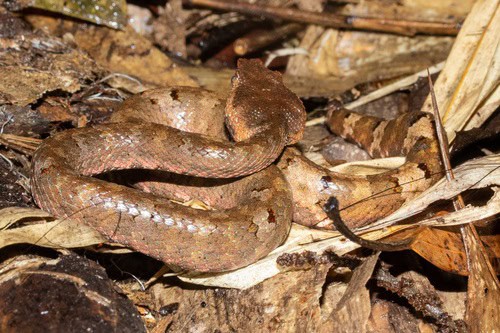
Maximum length: 87.4cm.
If the temple pitviper is Borneo’s main branch-dwelling venomous snake, then the Borneo pitviper (Craspedocephalus borneensis) is a halfway-house species. It’s somehow brown enough to blend with fallen leaves and twigs on the forest floor, yet can also disappear completely while clinging to a thick tree trunk.
This species is particularly common in the north of Borneo, appearing in the Malaysian states of Sarawak and Sabah alike. Its venom is poorly researched, as is the exact mortality rate, but the mixture contains several PLA2s and cytotoxins. Spotting this snake is a great accomplishment; it’s one thing to scan a few square metres of forest, but much harder to constantly scan every section of the forest as you walk forward. Tiptoeing forward inch by inch may be the only option in forests where the Borneo pitviper is confirmed to exist.
This species belongs to the 14-member Craspedocephalus genus, whose other members include the Malabar pitviper of India. Borneo pitvipers are known to prey on reptiles, including the great flying dragon (Draco maximus).
| 7 | Malayan whipsnake |
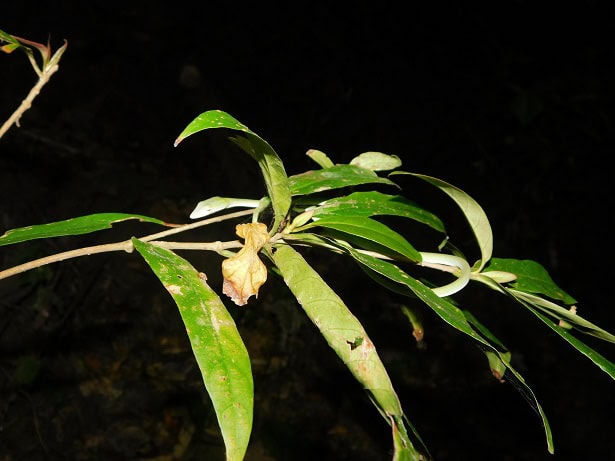
Maximum length: 110cm.
A mildly venomous species which appears in primary and secondary forests, and never in urban areas. Its camouflage ties in with this preference, as the Malayan whipsnake is a pure leafy green, blending effortlessly with vines, leaves and lower bushes. On a suburban street, this species would be incredibly easy to spot, but in the jungle, it’s almost impossible.
Malayan whipsnakes are extremely thin, and rarely exceed 1 metre. They prey mainly on reptiles, and can climb relatively high in trees. While the majority are green, there’s also a brown morph, which has equally strong camouflage on thick trees with gnarly trunks.
Malayan whipsnakes are secretive, but widespread across southeast Asia. They begin in southern Thailand, before covering all of peninsular Malaysia, northern Borneo, much of Sumatra and most of Java. They’re particularly common in Singapore, in the central belt of forested nature reserves, including Upper Peirce Reservoir Park and Windsor Nature Park.
| 8 | White-spotted catsnake |
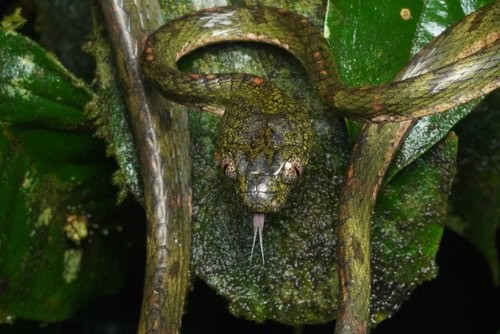
Maximum length: 2.1 metres.
A mildly venomous species, with several memorable physical features. The first is extremely large eyes, with a detailed pattern like a mossy forest floor. The second is an exceptionally thin body, one of the thinnest of the Boiga catsnake genus it belongs to. The final characteristic is an immense camouflage ability, blending into all areas of the forest with immense skill.
The white-spotted catsnake (Boiga drapiezii) ranges from southern Thailand, through most of Malaysia, all the way to Java, Indonesia. It’s mildly venomous, and preys on a mixture of frogs, geckos and smaller reptiles. Most of its life is spent on branches, but this species is also comfortable on the ground.
The white-spotted catsnake is so committed to camouflage that it even varies its appearance to make it more effective. There are green morphs of this species, as shown above; this version blends effortlessly with leaves and rain-soaked, mossy boulders. There’s also a brown morph, which blends effortlessly with dried-out leaves on the ground.
| 9 | Schneider’s bockadam |
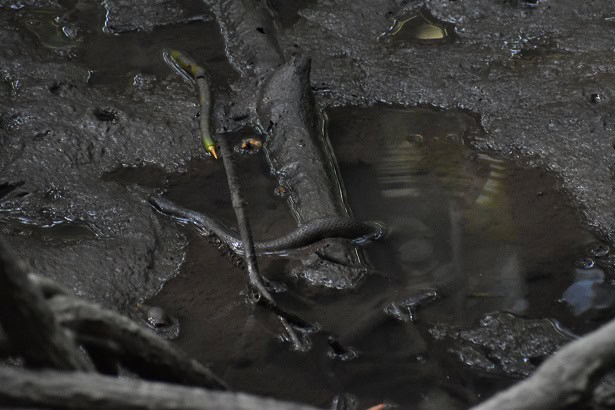
Maximum length: 127cm.
Rather than green leaves or twigs on the forest floor, this coastal species is designed to blend with grey mud, in estuaries and tidal flats. Schneider’s bockadam is a surprisingly common species, which few westerners have heard of, yet covers a large stretch of land. It covers the coastline from central Thailand, through most of Malaysia, all the way to Sulawesi, Indonesia.
Across that vast stretch of land, Schneider’s bockadam is difficult to see, due to its excellent ability to blend with mud. This species has no issue with submerging itself, or even rolling in mud, in order to further its schemes of stealthy disguise.
Schneider’s bockadams prey mainly on fish, and have a weak venom. They often take up residence in coastal pools, swallowing up swarming schools of fish, effectively living life on easy mode. They do face a few obstacles, however: the bockadam clan is confirmed prey for the king cobra. Their camouflage has a more important purpose than simply dodging scientists.
| 10 | Indo-Malayan mountain pitviper |
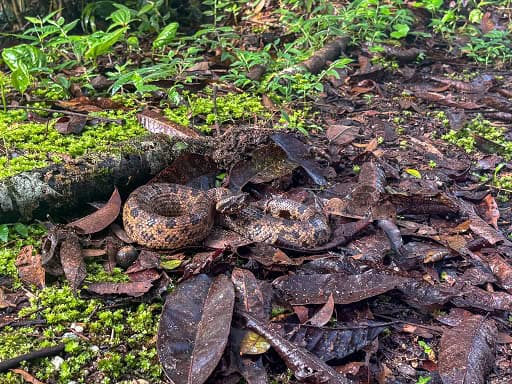
Maximum length: 71cm.
An uncommon pitviper found in peninsular Malaysia, extreme southern Thailand and Sumatra. The Indo-Malayan mountain pitviper (Ovophis convictus) is intelligent enough not just to dwell on the forest floor, but shift into the precise sections of leafy matter that match its scales.
In bright green grass, this snake stands out like a sore thumb. It’s the exact opposite of the Lanna green pitviper below. While Ovophis convictus may lack the ability to think and plan, an attraction to microhabitats of this colour has become programmed into its brain, creating a strong survival advantage.
A classic feature of this snake is a particularly dark head; the body alternates rapidly between brown and black, but the skull cap is almost completely black. Bites from this snake aren’t particularly common, as it’s mostly restricted to mountain areas. Its venom doesn’t seem especially potent either, as a study found it to be the least potent when compared to two Ovophis relatives, the Tonkin pitviper and Okinawa pitviper.
| 11 | Lanna green pitviper |
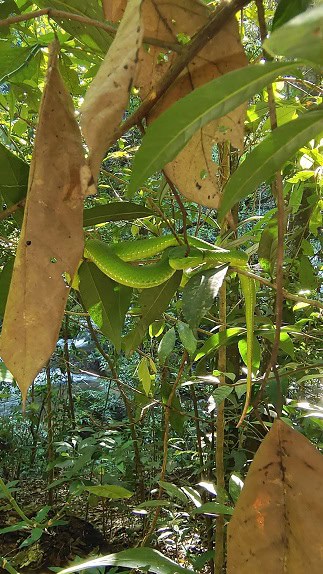
Maximum length: 85.4cm.
The Lanna green pitviper (Trimeresurus lanna) is one of the newest pitvipers in Thailand, not new in having recently evolved, but new in being announced. Originally, this species was considered to be part of Pope’s pitviper, but in 2024, that species was split in two, with Pope’s pitviper now being restricted to northeast India and Bangladesh, and the Lanna green pitviper taking over a large swathe of territory in northern Thailand and southern Laos.
Like other Trimeresurus members, this species mainly sticks to tree branches, but a difference is that the Lanna green pitviper appears in cooler environments overall. Rather than lowlands, it appears in hilly forests at 600-2000 metres, where the temperature occasionally drops as low as 5C.
The Lanna green pitviper is a risky species to encounter, as most Trimeresurus pitvipers have a cytotoxic venom, which unleashes painful swelling and necrosis. This is a species which you’d probably notice if you were facing it head on, but not out of the corner of your eye.