
There are three species of snake in Florida which have caused confusion more than any other: the eastern coral snake, the scarlet snake and the scarlet kingsnake.
The former is dangerously venomous, loaded with neurotoxins, which are capable of killing a human being via lung failure. One victim who died was a Hispanic man in a tent in 2006. The latter two are completely harmless; the scarlet snake is a non-venomous burrower which cracks open eggs and eats their yolks, while the scarlet kingsnake derives over 80% of its prey from reptiles.
The three snakes share red, black and yellow/white bands. They even share similar habitats, mainly forests and woodlands. The three have caused endless confusion, and a misidentification could prove deadly. Here’s all the information you need on separating these three iconic snakes…
| 1 | The colour ordering |
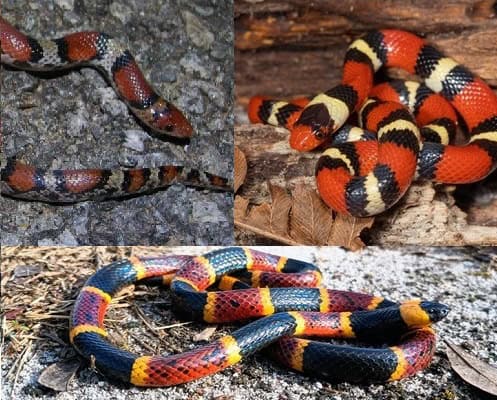
If all you care about is staying alive, as you wade through Florida’s swamps and tipoe through its pitch black forests at midnight, then you only need to know one difference. It’s the characteristic relayed in endless rhymes: the ordering of the bands. The rhyme goes something like “red touches black, venom lack”, or “red touches black, friend of Jack”, followed by “red touches yellow, kill a fellow”.
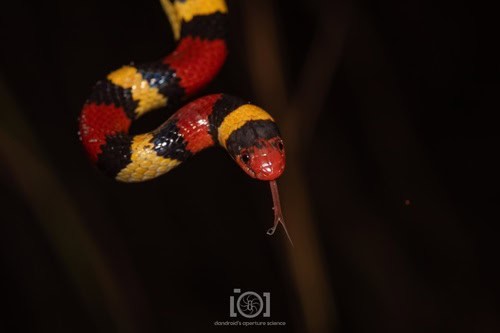
This rhyme fails miserably in South America, but works perfectly in Florida. The eastern coral snake is lethal and neurotoxic, and has large red spaces touching bright yellow. The overall ordering is red-yellow-black-yellow-red. This is repeated to the tail, where the red disappears, and the yellow-black continues until tapering away into non-existence.
Meanwhile, the harmless scarlet kingsnake and scarlet snake have the following colour scheme: red-black-white-black-red. The white is sometimes yellow in the scarlet kingsnake, and nearly always white in the scarlet snake.
If all you want to do is survive your local Florida forest, then you can stop here. But if you want more snake secrets, keep reading…
| 2 | The face |
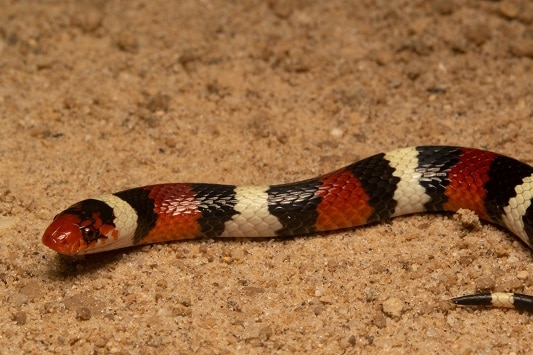
The next most obvious step is checking the colour of the face, and this is virtually infallible, at least when keeping you alive.
The eastern coral snake is recognisable by a completely black face, so black that it covers its eyes, like a sinister face mask. Its eyes are round and black, but spotting them in this shroud is very difficult, unless you bend down close enough to approach severe neurotoxic bite territory.
Eastern coral snakes vary little in appearance as well, so this black face is a consistent feature. As for its two non-venomous neighbours? Neither have a black face – in fact, both have a red face. In both species, the red covers the snout, and spreads behind the eyes, leaving them easily visible.
| 3 | The snout |
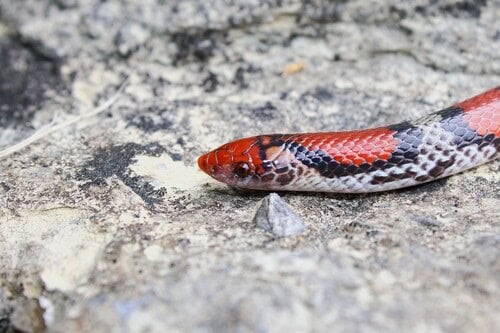
The shape of the face is a difference as well, as the scarlet snake is a burrower, much more than the other two. It spends its life in sandy woodlands with loose soils, and on sandy dunes, where it burrows down to locate turtle egg stashes. Consequently, this species has a narrow, tapering snout, to make its digging schemes possible.
Meanwhile, the scarlet kingsnake has a more rounded snout, and likewise for the eastern coral snake. Neither of these species digs extensively; while both dwell on forest floors, they tend to hide under loose material such as fallen branches, rotting stumps, and leaf litter rather than forging their own underground chambers. Narrow snouts are correlated with digging in snakes all over the world, and neither of these species has one.
Your head strategy is simple: a red face to establish harmlessness, and a spade-shaped snout to separate the scarlet snake from the scarlet kingsnake.
| 4 | The neck bands |
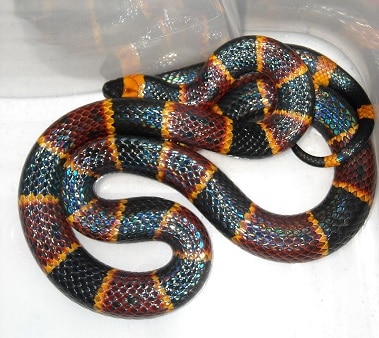
Behind the red or black face, you have the first rapidly alternating colourful bands, and this is another clear differentiator. The venomous coral snake and two harmless neighbours are clearly separate here, as the eastern coral snake follows its eerie, midnight black face with a thick neon yellow band (see above).
The scarlet snake and scarlet kingsnake are completely different. Both follow the red face with a jet black band, followed immediately by a pale band, and then another black band. The sequences are surprisingly similar, despite the two species only being distantly related. In both harmless snakes, the sequence from the head is red-black-yellow-black.
The tail is another differentiating factor. Eastern coral snakes lose the red for the entire tail, switching to yellow-black, while on the two harmless species, the sequence maintains its red until the end.
| 5 | The underside |
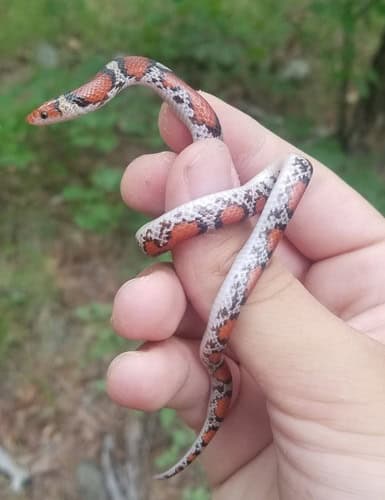
The single best way to conclusively identify a scarlet snake is its underside. Perhaps you’ve identified the band ordering, but still can’t separate the harmless two snakes, because there’s natural variation within each species, causing them to occasionally overlap. Never fear – the scarlet snake has a purely white underside, and is the only one of the three which does. The black and red bands halt completely on the sides, and don’t spread to its belly.
Meanwhile, the eastern coral snake’s bands barely change on its belly. The feared red-yellow-black bands form complete rings, touching in the centre. They also maintain roughly the same width, with the yellow bands being particularly thin.
The scarlet kingsnake is intermediate between the two. The belly/underside has more black markings overlaying the white than a scarlet snake, but it isn’t a clean circle of the bands. The same rough colours continue on the belly, but become much more disorganised.

Of the three, the scarlet snake easily has the most cleanly pigmented belly.
| 6 | The secret sign |
Overall, scarlet snakes and scarlet kingsnakes are much trickier to differentiate from each other than from their venomous neighbour. Eastern coral snakes look far different when you have the basic knowledge, but these two? Even the main ID signs can be hard to spot, like the cleaner underside, which it won’t conveniently let you see by flipping over.
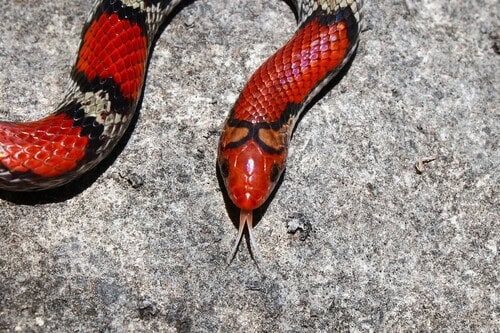
However, there is one great secret ID sign which makes a scarlet snake easy to spot. It’s like a secret button, one which you don’t press, but instantly lay your eyes upon and gain access to the truth. It’s the scarlet snake’s first pale band, the one immediately after the thin black band after the red face.
Both species have this pale band in the same order: red, black then pale. But in the scarlet kingsnake, the pale bands are the same colour all over its body: yellow or white, which applies to this neck scale too. The secret ID sign is that in scarlet snakes, this neck scale is usually yellower than the pale scales on the body. The body pale scales are snowy white, but this scale can even be orange-ish, and definitely a fruity yellow. See the image above for a great example.
| 7 | A mostly reliable secret sign |
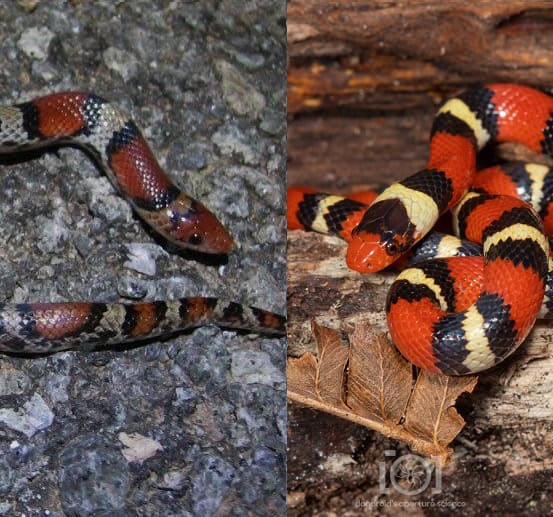
There’s another secret differentiator between our two harmless species as well. The first black scale is the thin band after the head, then there’s the pale patch in both, and this is followed by the 2nd black band, at the bottom of the neck.
This ID sign is one you can’t unsee once you’ve seen it, but isn’t immediately obvious. From a bird’s eye view, the shape of this band differs significantly in the two species.
In the scarlet kingsnake, the 2nd black band is much straighter. It forms a neat, mostly straight row, continuing from the red-black-yellow descending from the head. But the scarlet snake is generally much different. This 2nd black band normally has a curving shape at the sides.
If your bird’s eye view is facing the snake travelling forwards, then the edges of the 2nd black band will curve back towards you, forming a curve slightly more than a horseshoe, but less wide than a rainbow. This is evident in the image above.
The rule is a straight-ish 2nd black band for the scarlet kingsnake, and a backwards curving one for the scarlet snake. Due to morphs and natural variation, this isn’t 100% consistent, but it’s another great secret ID signal.
| 8 | Scarlet snake: yellow bands are very rare |
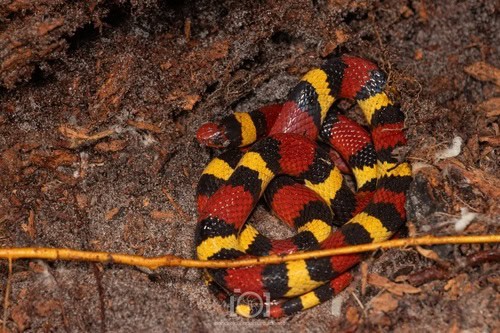
Next we have a very basic ID sign, which is useful around 50% of the time. The scarlet kingsnake is a variable species in colour, and specifically with the pale bands. The ordering of the bands is always identical, but some individuals have white pale bands, while in others they’re yellow.
The scarlet snake, meanwhile, is almost completely consistent: the pale bands are all snowy white (except the 1st on the neck). If you find a white-banded individual, this fact won’t help you, but if you find a scarlet kingsnake with yellow bands, then a quick look at the band ordering will tell you that it’s not only completely harmless, and not a coral snake, but that it isn’t a scarlet snake either.
This ID sign is therefore useful in around 50% of encounters, but could help you skip the more technical signs like the 2nd black band’s shape or the tapering snout.
| 9 | Length: fairly similar for all three |

If you’re hoping that length is an instant way to separate this snake from others, then bad news: the snake kingdom won’t make it that easy for you. These three snakes have very similar lengths overall, enough that we humans lack the visual acuity to instantly separate them.
The eastern coral snake is the longest of the three, with an all-time record of 129.5cm. The scarlet kingsnake is the shortest, at a record of 72.0cm, while the scarlet snake is intermediate at 82.3cm. The scarlet kingsnake is actually the shortest member of the Lampropeltis kingsnake genus (26 members) that it belongs to.
Anyway, adults will overlap in size significantly, so length isn’t an instant way to identify these Florida species, unless you find one which is clearly over 1 metre. All three are fairly similar in width as well; the scarlet kingsnake is the thickest, but not by a significant amount.
Another similarity of all three is round pupils; none have the vertical pupils of a viper.
| 10 | The 1st black band |
Finally, we have an ID sign which is reliable in maybe two thirds of cases. The scarlet kingsnake and scarlet snake have a red face followed by a black neck band – this is consistent in almost 100% of individuals. But in the scarlet kingsnake, the blackness often extends further into the red head, on the top of the skull.
You can see this in the image above. The black isn’t just more extensive, but becomes messier, forming disorganised lines and speckles. In the scarlet snake, meanwhile, the first black band tends to be thinner and more organised. By extension, the red head tends to be cleaner, particularly towards the top of the head.
Again, this isn’t always consistent, as some scarlet kingsnakes have a smaller 1st black section than others, but it’s another mostly reliable ID sign to combine with another, and another, until you’re 99% sure.
| 11 | Concise summary |
Here’s the final word then. The eastern coral snake can be separated from the harmless two species by…
- Red touching yellow, never black, as per the famous rhyme.
- Bands which fully encircle the body, continuing uninterrupted on the belly, without changing in width.
- A jet black face, followed immediately by a thick yellow band.
The scarlet snake and scarlet kingsnake are trickier to separate from each other, but here’s how:
- The scarlet snake has the cleanest, most pristine white belly.
- The scarlet snake has a narrow snout, designed for burrowing.
- The scarlet snake has a yellower 1st pale band from the head than its other pale bands. The scarlet kingsnake has consistently white or yellow pale bands.
- The scarlet kingsnake has a messier 1st black band, often extending into the red head (not 100% consistent).
- Scarlet kingsnakes are split evenly between 100% yellow pale bands, or 100% white pale bands. Scarlet snakes almost always have white body bands.
- The scarlet snake has a 2nd black band which curves backwards at the edges, towards the tail (not 100% consistent). The scarlet kingsnake’s 2nd black band is more even.
Follow these steps and you will never misidentify a bright, multicoloured Florida snake again. Soon you will be the master of all you survey. The snakes of Florida will bow to your commands and even the vibrations of your brain cells as you issue telepathic orders. Actually, they’re more likely to ignore your presence completely, undisturbed by the crunching of leaves in their sheltered forest domains.
Even the eastern coral snake is a shy snake which is mostly disinterested in humans. The 2006 victim was drinking beer in a tent, and unlucky enough that the coral snake crawled into his tent by accident. Never touch a coral snake, but this species rarely makes lunging assaults like a pygmy rattlesnake or copperhead.
THE END