
| 1 | The snake African birds fear most |
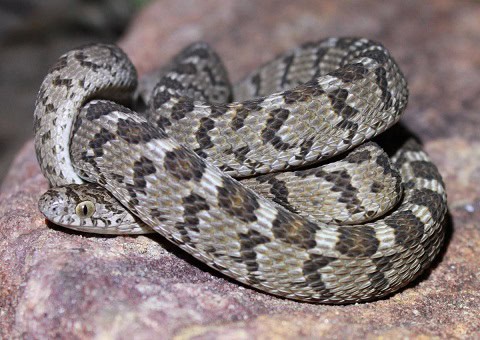
The location is South Africa. A bird is guarding its egg nest, carefully monitoring the savannah below. It doesn’t feel the slightest bit of worry when it sees a lion, a hyena, a hippo, or even a cunning crocodile move slowly past. Those species pose no threat to its eggs and therefore its future offspring. But there’s one creature which all birds in South Africa fear, and will do anything to hide from – the common egg-eater, AKA the rhombic egg-eater (Dasypeltis scabra).
The common egg-eater is completely non-venomous, and poses no threat to humans whatsoever. Nor does it have any aggressive, ripping teeth. Instead, this species survives by being perhaps the most highly evolved egg hunter in the entire snake kingdom, alongside its Dasypeltis cousins further north (e.g. the montane egg-eater of Kenya).
Common egg eaters don’t just swallow eggs whole without tearing their necks apart, but have a God-like ability to seek out egg stashes. You might not think that a pile of bird eggs gives off any scent at all, but Dasypeltis scabra has such a finely tuned scent apparatus that it can track scent molecules directly to the source. Eggs form 100% of this species’ diet, with no dabbling in mammals, reptiles, or even birds themselves.
| 2 | Spread far and wide in southern Africa |
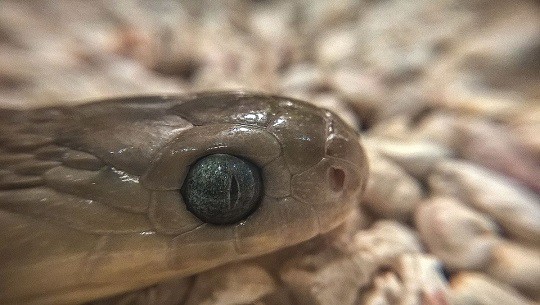
Common egg eaters are fairly small, albeit not tiny, with an average length of 60-70cm, and an all-time confirmed record of 116cm. Their pupils are vertical, correlating with their habit of moving by night.
Geographically, this species is most common in southern Africa, but spreads a decent way to the north. Common egg eaters are abundant in eastern and southern South Africa, and less common in the far west and north of the country, but still present in lower levels. They’re found in parched Namibia as well, and are abundant in southeastern African countries like Zimbabwe, Mozambique, Tanzania, and Botswana.
Common egg eaters are also abundant in Kenya, alongside several other Dasypeltis members, like the montane egg eater, which sticks to higher altitude areas at over 1500 metres, with Dasypeltis scabra preferring lowlands. The northernmost extent of the common egg eater lies in Ethiopia and Sudan, where they’re thinly spread, but still lurk quietly. To the west, this species reaches as far as northeast Nigeria before suddenly disappearing, with no presence at all in west African nations like Togo, Ghana, Liberia, Ivory Coast, etc.
The habitats of this species are immensely flexible. Common egg eaters can appear in forests, semi-deserts, meadows with thickets, dry and wet savannahs, and also manmade gardens. Towns are perfectly acceptable for them, as they’re abundant near Cape Town, Pretoria and Nairobi alike.
| 3 | Style of egg-eating |
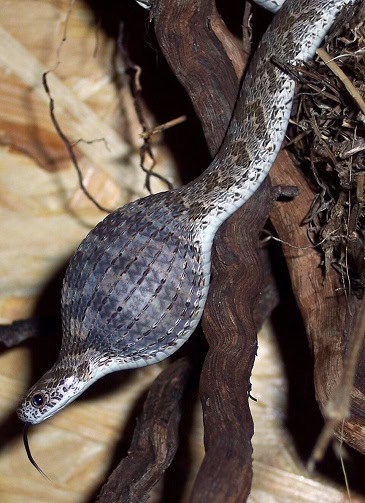

Egg-eating snakes around the world have various different styles, like the scarlet snake of Florida, which hacks into whole turtle eggs with an enlarged front tooth, and slurps out the yolk without swallowing the actual shell. The Dasypeltis genus is completely different, swallowing eggs whole before regurgitating the shell.
After locating a nest via scent, the common egg eater begins by rubbing its nose against an egg to test its shape and size. After enough probing, the egg-eater begins to swallow the egg without cracking it, moving what looks like a bowling ball through its mouth. Dasypeltis members not only lack sharp teeth, they have no teeth at all, in order to make swallowing eggs virtually frictionless.
Eventually, the egg passes into the egg-eater’s neck. At this point, Dasypeltis scabra cracks the egg’s shell using a series of sharply protruding hypapophyses on its spinal column, shattering it from within. The liquid from the egg is swallowed, while small foetuses inside may also be swallowed.
As for the shell, the common egg-eater begins to compress and squeeze it into a neat package. Then it regurgitates the entire shell remnants, which have been described as being a “boat shape”.
| 4 | More feeding adaptions |
Common egg-eaters are able to swallow bird eggs measuring 4 times the width of their own heads. Interestingly, their head size has no involvement in these skills. In fact, when a study compared them to 3 egg-eating (not exclusive egg-eating) snakes they coexisted with, the boomslang, mole snake and cape cobra, it found that the common egg-eater had the smallest head proportionately, despite being 100% reliant on eggs rather than only partially.
Instead, it’s the flexibility of this species’ jaws which allows it to swallow eggs whole. Common egg-eaters have highly elastic skin around the throat, allowing for grotesque stretching. The connective tissues of their jaws are equally elastic, and as the image above shows, their entire jaw appears to be a different shape to most snakes, in order to accommodate eggs.
It’s also theorised that common egg-eaters lubricate eggs somehow as they pass down their throats. Another confirmed adaption is small ridges lining the inside of the mouth. Like human fingerprints, these miniscule ridges allow for superior grip, holding eggs in place as the egg-eater patiently works them down.
| 5 | Species whose eggs it steals |
Dasypeltis scabra is confirmed to eat the eggs of many bird species, including the cape longclaw, cape pipit, common quail, Namaqua sandgrouse, and white-breasted cormorant. In a study lasting from 1989-1994, scientists visited Meeuw Island and Schaapen Island near Cape Town. Both of these offshore islands host a colony of secretive common egg-eaters, which tend to lurk in dark cracks, including in rocky cliffs. The scientists struggled to find the snakes themselves, but managed to find a few predator records by checking discarded shells in rock crevices. The new records included eggs of the rock pigeon, kelp gull and cape cormorant, lengthening the overall list significantly.
Then there’s chickens. Various chicken coop owners have been confused when their eggs started disappearing, only to find a satisfied-looking Dasypeltis scabra in the coop one day, resting on hay as though proud of its work.
One study fed large and small eggs to rhombic egg-eaters: chicken eggs and finch eggs respectively. The chicken egg shells were always regurgitated, but the smaller quail egg shells didn’t reappear, showing that smaller eggs sometimes get swallowed fully. The same is true for foetuses inside eggs; smaller ones are sometimes swallowed, while larger ones are regurgitated along with the shell.
| 6 | King of shelter |
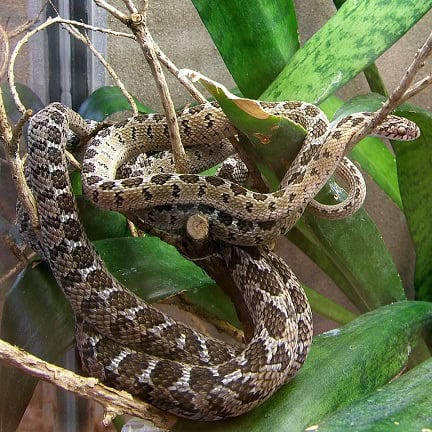

Eggs are hidden all over the African countryside, right, centre, up, down, forwards, backwards, and in dark, inaccessible places. Consequently, common egg-eaters are equipped with various skills in order to track down their secretive locations. They generally dwell on the ground, on rocks, grass and bare soil, but are more than able to ascend tree branches if the scent trail of a promising egg stash lures them upwards.
Wherever they go, common egg-eaters move relatively slowly, probing the countryside for clues like a detective. They’re the opposite of a cobra, which knows no limits, and no speed other than hyperactive mania.
Most of these hunting exploits occur during night, as common egg-eaters are heavily nocturnal. During day, they can be very difficult to find. Common egg-eaters are experts at stashing themselves away in dark, unseen corners of the savannah. Hangouts include hollows in tree trunks, dark rock cracks, and also abandoned termite mounds. They even shelter in birds’ nests themselves, perhaps right after swallowing the eggs they contained.
| 7 | Shocks with a black mouth lining |
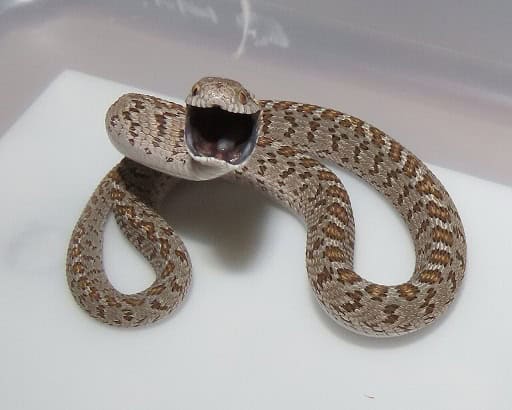
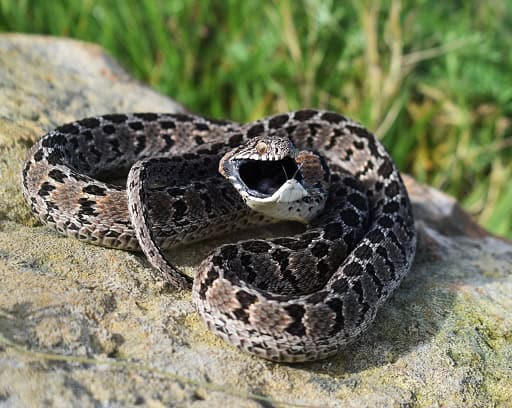
The rhombic egg-eater lacks any venom. It lacks any fangs, or ability to poke you with a sharp tail. But it often bares its mouth wildly anyway, and the reason is one of its main defensive tactics: a jet black mouth lining designed to intimidate its enemies.
Like the cottonmouth of the USA, which shows off a snowy white mouth, Dasypeltis scabra only has to open its mouth to startle potential predators with an intense flash of colour. Even a human being might find it momentarily disturbing. This feature is also found in other Dasypeltis members like the montane egg-eater further north in Kenya. Among unrelated snakes, the green vine snake of Brazil also has a near black mouth, contrasting against its bright green scales.
Exactly how strongly this pitch black mouth deters predators is unknown. Research is thin on this species’ predators, but one of the few confirmed is the cape file snake (Limaformosa capensis), a notorious snake-eater with rough scales, which is common in South Africa.
| 8 | Mimics vipers |
This disturbing mouth isn’t the common egg-eater’s only survival tactic. Firstly, this species looks completely unhinged when it bares its mouth as well, intimidating its enemies further.
Secondly, the common egg-eater can be a close mimic of a local viper, one which it overlaps with across a high percentage of its territory. Its murky colours could potentially mimic the larger puff adder as well, but this species is a particularly close match to the rhombic night adder (Causus rhombeatus). This 50-80cm species is less venomous than other African vipers, but still able to send victims to hospital with a severely swollen arm.
Dogs have died from Causus rhombeatus bites and predatory birds will doubtlessly give them a wide berth. Hence, the common egg-eater has evolved to mimic this snake, both in its thickness, size and body patterns. Rhombic night adders even have a specific head marking which common egg-eaters sometimes copy: a V-shaped marking, visible from a bird’s eye view. Whether this appears in the common egg-eater depends on the local morph.
| 9 | Even triangulates its head |
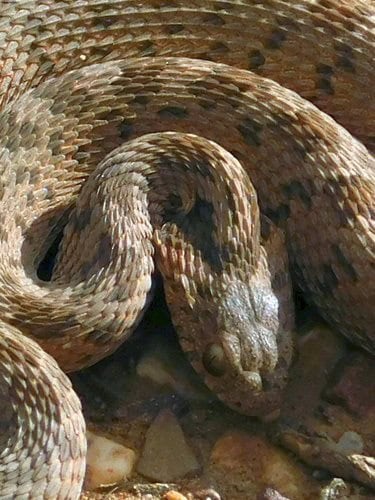
Common egg-eaters don’t stop there with the mimicry. They take their deceptive skills to the next level, altering not just their scales, but their entire skeletal structure, as this species possesses the ability to triangulate its head.
Ordinarily, the common egg-eater possesses a small, tube-like head. Again, it’s the flexible jaws and elastic throat skin which allow this species to swallow eggs whole. But in times of stress, common egg-eaters are able to flex bones in their skull to create a triangular shape, making them even more similar to local vipers like the rhombic night adder.
This transformation occurs extremely quickly, with no gradual shifting in complex bone plates and joints, just an instant triangular shape, the moment a greedy predator approaches. For a local villager, farmer, or football team in South Africa, it can make identifying the common egg-eater very difficult. This triangular head can make the species easily confusable with a viper even if you’re fully equipped with the knowledge (perhaps after reading this article).
The pupils aren’t a giveaway either. Usually with vipers, whether it’s a rattlesnake or adder in the UK, the vertical pupils will inform you that it’s a venomous viper. But the rhombic night adder is one of the few vipers worldwide to have round pupils. Meanwhile, the common egg-eater has vertical pupils, but Bitis adders in South Africa like the puff adder and horned adder have vertical pupils as well. This is one of the trickier viper mimics to conclusively identify, depending on morph.
| 10 | Variable colours |
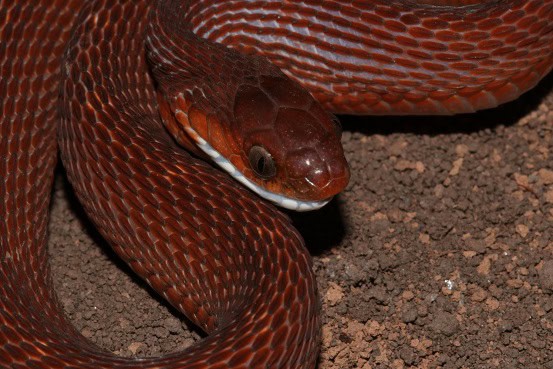
The final survival skill of this species is a simpler one: camouflage. Common egg-eaters blend in with ease, appearing as beige in semi-deserts, grey in rockier environments, and brown elsewhere. If a common egg-eater is smart enough to stick to disguising thickets, long grass and tangled woodlands, it will blend in and survive with ease, and a mother bird will struggle to tell when one is creeping up on her eggs.
This relates to yet another of this species’ memorable features: its high amount of colour morphs. The red egg-eater above is a classic example of a common egg-eater that looks wildly different to other members, so different that it appears to be a different species. The photo was taken in Tanzania, but others nearby are grey adorned with black blotches.
A study from 2025 confirmed that different common egg-eater morphs appear within the same locations, finding 3 significantly different morphs on one farmstead in Vredefort, central South Africa. This included a heavily marked form, a plain morph, and an intermediate form with plainer patterns. The colours varied, as the plain morph was mostly grey, while the intermediate form had a clay red tinge.
According to the study, the striped form of Dasypeltis scabra is the rarest; this consists of a thick vertebral stripe all the way down the spine. There’s some correlation with location, as the plain morph is more common in highland areas of central South Africa, but always with great unpredictability. For example, in Free State, central South Africa, plain morphs comprised 9-10% of all Dasypeltis scabra members, but at a farm near Lindley, 6 out of 9 common egg-eaters collected were the plain morph.
| 11 | Its own eggs |
Dasypeltis scabra may feed on eggs, but it also lays them in order to survive. This species lays a fairly normal clutch size, typically producing 6-28 eggs at once. However, females can produce more than one clutch per season, giving the species a survival advantage, and possibly explaining how it’s grown to be so common.
Hatchlings of this species typically measure 20-28cm. The eggs themselves are described as having small, pimple-like protrusions on the shell’s surface.
There is one remaining question that may have occurred to you. Do common egg-eaters ever get tempted to eat their own eggs, and give in for a quick meal? Cannibalism has been reported in multiple snake species worldwide, so it’s conceivable. In this case, the answer is probably not, as common egg-eaters derive virtually their entire diet from birds’ eggs, not reptile eggs.